Confronting Envy


It started innocently enough with an online sale. The kind of online sale that let’s you meet likeminded parents: cloth diapers, children’s bikes. This one was for a ring sling. While teaching the buyer to use my ring sling, we had stricken a conversation about twins. This young mama had 6 month-old twins, her first children. I looked at her with the confidence of the mother who has it all figured out and said: “I know how tough it is right now but don’t worry: they’ll sleep someday, it gets better.” She said: “Oh sleep is no problem! Since they were born we made sure to have a really consistent bedtime routine and when we tuck them in their beds they know it’s sleep time and they just go to sleep!”

Well, I try hard not to swear but F-my-luck. I haven’t slept a good night since 2009 and having twins nearly killed me. From the day they were born until Lucas was 16 months I did not sleep longer than 45 minutes in a row. When he was 10 months-old I realized that I had seen every single hour on my alarm clock, every single night, for the last 10 months so I got rid of the alarm clock. It was easier than getting rid of the baby. That young mom’s innocent comment made me feel like maybe I had missed something. Maybe I could have been sleeping all this time and my restless nights were due to a lack of skills or determination. And those negative feelings reopened a door I had long thought closed: the door of envy.

St. Thomas Aquinas defined envy as sorrow at the good fortune of others. Its flip side is rejoicing at the downfall of others. Envy is that silent “YES!!” moment when we learn of the downfall of someone we had been envying. As if something in us died when our neighbor succeeded.

IMG_3623

I struggled for many years with envy after my older children were born. I was convinced that my decision to put my career on hold while my children were young (ha! Famous last words as I still have young children almost 20 years later) was the right decision for our family. Yet, I looked with envy at the material things my friends who worked outside the home could afford. Vacations, cute clothes, and my holy grail, matching furniture. I mentally wished that their children would grow-up troubled as if I needed to see the proof that having a parent at home was better for children. As if nothing I was doing would have been worth it unless my children were happy and their children were screwed-up.

Now that I am a bit older and a bit wiser — and that I have a house full of matching IKEA furniture — envy doesn’t rear its ugly head the same way it did when I was younger. I no longer envy material things as much as accomplishments. I envy confidence, safety, and a sense of control. Which is ironic isn’t it, since I decided to have a large family? But this is how fear works in the darkest confines of our souls, keeping us from becoming a better, bigger, version of ourselves.

I caught myself wishing that this young mom’s twins would suddenly stop sleeping so well. To show her that she wasn’t really in control. I wished that she would discover that her parenting skills at imposing a bedtime routine that sent her kids straight into Morpheus’ arms had everything to do with her children’s natural disposition to sleep on cue. I assumed that they must have been bottle-fed in hospital and molded to an institutional schedule. What are we breastfeeding mothers to do when our healthy children protest our best attempts to conform them to our schedule? We are not going home at the end of our shift!

IMG_1134

A few months later, I learned that a friend with children had sold her house and purchased a similar-sized house in a less desirable suburban neighbourhood. The difference in prices allowed her and her husband to pay-off their mortgage and live comfortably debt-free.  I could just taste the freedom. Completely debt-free, home owning, new vehicle driving, holidaying, while in their prime earning years, with school-aged children…. Life: does it get better than that?

Well, of course the husband, you know…. And the wife well… That’s not mentioning the way their kids…. And the issues at school… Here comes envy again with its messy greasy hands leaving fingerprints all over my best wishes. Envy is the opposite of rose-coloured glasses. It stains what should be beautiful and inspiring and filters it through a dirty lens. Turned on itself, it makes us look like a diminished version of ourselves. Envy is self-limitation. It’s locking ourselves in a cage, with the key, wishing every one would join us in when we could simply fly away.

I realized that my envy was not only holding me down, it was preventing me from growing from my experiences and choices, whether good or bad. It also made small-fry of the fruits of those experiences and forks in the road. My life as a mother of 9 is fodder for this blog and countless helpful interventions with friends and strangers alike. I made poor financial and academic decisions that set me back in my career ambitions and my financial independence but these decisions have lead me down a path where I met dear friends, learned valuable lessons and grew more than I ever did playing it safe. Envy renders us myopic, deliberately blurring out distance and perspective, only allowing us to see what is directly in front of us. IMG_4132

How many “mommy wars” and “mama drama” are rooted in envy? How many poor choices are motivated by envy? How farther along would we be if we simply chose to learn from those who have done things better, or even just differently, than we have?

C.S. Lewis described hell as a door locked on the inside. When we let envy     pollute our relationships with others, we are not only locking ourselves in but expecting everyone to join us.

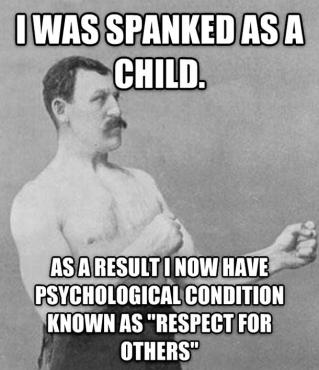
“I was spanked as a child and I turned out fine”


A Facebook Friend (who is also a blog reader, hi!!) recently posted this meme on her timeline:

for-those-of-you-who-are-against-spanking-your-children-79911

As a result of spanking or in spite of it?

Hitting children is not new and the world has kept on turning, I’ll concede the point. But I always get a chuckle when people claim that despite something “they turned out all right” . From politicians to policy-makers, business and community leaders, from the smallest to the largest units, people “who turned out fine” are having the babies, making the decisions and overall having a direct impact on the world we live in.

The numbers are in and can we really pretend that “we turned out all right”? Whether you lean left or right, it’s hard to argue that everything is all right with the world today. As a society, we’ve been unwilling to care enough about the consequences of our purchase decisions to pay for their actual cost. From environmental degradation to sweat shops, if our wallets are happy, we’re content to let “others” live with the consequences of our actions. We have a hiccup of remorse when tragedies like the Rana Plaza put us in front of our lifestyle choices but not enough to change anything. That would require sacrifice. And sacrifice is hard, especially when it involves others. We like the kind of sacrifice that get us ahead somehow. Like saving money, or going to school. Paying $200 for a pair of ethically sourced shoes? What’s in it for me?

Any minute increase in the price of gas  or electricity sends us writing to our MPs. Heaven forbids we should pay the actual cost of our endless thirst for energy. We want the SUV and the soaring two-storey windows in a sub-polar climate, how are we supposed to have this without energy subsidies? We subsidize the rich and the poor equally in the name of an infantile understanding of fairness. We hate to pay taxes, yet expect Cadillac entitlements on a K-car budget. Let the others pay the taxes. We shake our heads in contempt at governments’ willful blindness on debt, deficits and quantitative easing, yet we run our personal spreadsheets according to similar principles. We vocally take financial institutions to task for raking-in record-breaking profits while doing the same thing with our personal money. Let them share the banks’ obscene profits but not those of our favorite sports and entertainment personalities. We elect tax-cutting governments, then turn around and require social services. We suffer from a collective inability to be consistent with our political and economical beliefs. It’s all about me: my money, my entitlements, my job, my lifestyle, my stuff. We lean left when the State giveth and right when the State taketh away. We are unable to see that our day-to-day decision-making reflects that of the world leaders and financial planners we so adamently denounce for their self-serving ways.

We were spanked as children and turned out all right, yet incidences of mental illness and addictive behaviours are soaring, not only amongst ourselves but in our children as well. School yard bullies and victims grow into workplace bullies and victims. We profess zero-tolerance as harassment and belittling reduce our neighbours and colleagues to rubble. We reach deep into our reserves of righteous indignation when a child dies at her own hands but we look the other way when the hazing happens in our own backyard. How many parents of bullies were spanked as children and turned out all right? How many bullies have grown out of attachment voids passed down generations? Meanwhile, social and medical academic litterature has been linking addictive behaviours to unmet attachment needs since the ’70s and we keep spewing nonsense about “turning out fine.”

We are not fine. Our marriages are not fine. We are unable to put others’ wellbeing before our own, even when research consistently shows that children are wounded even by the most amiable of family breakdowns. Whenever someone declares that they were spanked as children “and turned out fine” I always want to start a game of 20 questions: oh yeah? How’s your relationship with your teenagers? How many relationships have you left? How’s your relationship with your boss? Your colleagues? Authority? Your faith? Are you still with your spouse? Is it possible that the voids in your life might have been left by unmet attachment needs? Would you entertain the idea that being hit by your parents might have had an influence on your inability to persevere through challenges or — the opposite — to leave abusive relationships?

We suffer from that psychological condition known as “respect for others” which causes us to share heartwarming viral stories about disabled people beating all the odds while we terminate our disabled pregnancies in ever increasing numbers. With the growth of prenatal diagnosis and the expectation that “the government” will take care of our medical needs, the primary care of physically and mentally disabled people has become a matter of choice. We call ourselves tolerant, fighters, believers. But when our turn comes to rise above, accept difference and take a chance at love when love is scary, we refuse. Today, 9 out of 10 pregnancies of children affected by Down Syndrome are terminated. Our psychological condition known as “respect for others” doesn’t extend to our own children, which we are not quite ready to love unconditionally. We tolerate difference only in the most limited sense of the term: to allow the existence of something that we do not necessarily like or agree with. We celebrate difference on the outside but on the inside we believe that the disabled life is not worth living. 

In a recent ad for a radio segment on Alzheimer’s disease, the announcer declared: “Alzheimer’s: first it robs you of your memories, then of your physical abilities, and eventually of your dignity…” Does it really? Is the indignity of the aged and the ill such an accepted fact that we no longer pretend to respect them? Our psychological condition known as ‘respect for other’ is an exclusive club where the “other” worth respecting is young, healthy and suitably well-off. The poor and the downtrodden need not apply: we’re so full of “respect”, we no longer have room for compassion. 

So stop with the memes already and go hug your kids. Your parents’ smacks are not genetic, you don’t have to pass them down a generation. Let’s see if love can build a better world than spanks have.  


Ontario’s new Health and Phys Ed curriculum: this is not a cafeteria


The roll out of Ontario’s new Health & Physical Education curriculum (better known as “sex ed”) has caused a flurry of activity on my Facebook feed. I feel blessed to have friends and acquaintances on every side of this issue but it makes Facebook commenting a bit of a mine field. Try as I may to post nuanced positions, the reality is that social media is a not a friend of nuance. That’s why I have my blog: so I can annoy everybody — from left to right — at the same time… But only if they choose to read me.

This? That's me in my natural state.

First, let’s get the elephant out of the way. I am a practicing Roman Catholic. As a matter of religious doctrine, I believe myself — and that handsome guy I make kids with — to be my children’s primary educators. This means that the responsibility to choose what my children learn falls squarely and unequivocally on my shoulders. The decision to send my children to school or to keep them at home is a religious right, or should be. Many Catholic parents oppose the new sex ed curriculum because they see it as an usurpation of parental authority and their role as primary educators. Not, take note, because they are afraid of the real names of their genitals or what they are used for. In fact, many of us wish teens would learn more about how their reproductive systems work. More on that later. 

I am a Catholic parent but I am also a citizen. I live in a democracy which is — as Sir Winston Churchill reminds us — the worst form of government except for all the others we have tried so far. When Premier Dalton McGuinty announced the new and improved curriculum a few years ago, the outcry on the eve of provincial elections caused the hasty retreat of the controversial new elements. The new Premier Kathleen Wynne promised to reintroduce the curriculum and is showing no sign of backing down. The people who have elected her are reacting with a collective shrug or, as a Facebook friend of a friend wrote: “I’m so glad they’ll be teaching consent.” Because really, how else are young men and women supposed to learn what a consensual sexual relationship is unless they learn it in school? My point is that the people who elected the Ontario Liberal Party are generally happy with the curriculum changes, either because it reflects their own values on health and sexuality or because they don’t care. The parents currently storming the barricades are not those who elected Premier Wynne. Is it a surprise to learn that she is not sensitive to their plight?

As my friend John Robson explains very well in this short video, the provincial government is in the business of teaching civics and morals. You may argue that the government should limit itself to value-neutral academics such a reading, writing and arithmetic but this would be a theoretical exercise at best: the Education Act spells the role of the school system in shaping values and morals very clearly. You’re in for a penny you’re in for a pound: once your children are under the auspices of our state-run education system, the system makes the rules. And that includes the rules about dating, mating and reproducing (or, preferably, not reproducing). As Justice Deschamp wrote for the majority in the 2012 case pitting Quebec parents against the Quebec government over the contested Ethics, Culture and Religion (ECR) curriculum (emphasis is mine):

Parents are free to pass their personal beliefs on to their children if they so wish. However, the early exposure of children to realities that differ from those in their immediate family environment is a fact of life in society. The suggestion that exposing children to a variety of religious facts in itself infringes their religious freedom or that of their parents amounts to a rejection of the multicultural reality of Canadian society and ignores the Quebec government’s obligations with regard to public education.

Yup. That’s right. While this decision refers to a different curriculum in a different province, it does a good job of highlighting the highest court’s sentiment with regard to parental rights in education. I have heard many people, several teachers themselves, argue that the school had to teach sex ed because the parents weren’t. That’s not true. The Ontario education system has to teach sex ed because matters of civics and morals are part and parcel of its mandate. You might argue that this does not correspond to your idea of civics and morals but you ascribed to that vision when you registered your children in school. Remember that dotted line? Your name’s on it.

In an address at the Maryvale Academy Gala last January, Ottawa Archbishop Terrence Prendergast  tore into Kathleen Wynne’s new Health & Physical Education curriculum calling it a “seizure of parental authority”. He said (emphasis mine):

“We know that the proposed program threatens the fundamental right of parents to educate their children in the moral dimension of sexual behaviour (…). Parents are best qualified and have the greatest interest in working with their own children to handle this serious topic at an age and developmentally sensitive time,” he continued. “More notably, parents have the fundamental right to do so―a right the Province appears willing to usurp without due consideration.”

(You can read the entire address here.)

Willing to usurp? The Province is not merely “willing to usurp” the role of parents as primary educators, it’s obligated by law to do so. As for the fundamental right to educate children in matters of morals, this is a right that is not recognized by law. As the Supreme Court clearly stated, that right stops at your front door. Some of my Facebook friends who support the curriculum updates shrugged: “It’s a great curriculum. Those who don’t agree just have to opt out.” Believe me, as a parent who had to pull an anxious child out of Health & PE:

ikeiw

I had to collude with my daughter to find out exactly when to pick her up. Had my daughter not been a willing participant, I would have had no way of knowing when the Health component of the PE class was being taught. Then she would be marked as “absent” — which adds up on her report card — and still expected to write the Health & PE test, failure to do so would also show on her report card. I was glad to give my daughter an occasional break from “Health” but on the whole, she still had to learn the stuff and write the test. Opting out? Not exactly. And here’s the difficult lesson of my post so far: you can’t really opt out of Health & PE even though you have a theoretical right to, as per the Education Act. You have to opt out of the system. We took our children out of Health. And French, math, science and history too. We homeschool. You’re not happy with the extent of government encroachment on your role as primary educator? Your options are: (1) change the Education Act; (2) force the rolling back of the curriculum by electing a government that supports your vision; (3) take your children out of public school. I’m sad to inform you that the happy middle where you get to send your kids to school to learn things you want them to learn at the exclusion of those you don’t like is not an option. Sorry. This is not a cafeteria.

Education is always political. Remember what they say about the hand that rocks the cradle? Well, if you don’t, the Provincial government does, as does Canada’s highest court. There is no such thing as a value-neutral sexual education class. The term “safe sex” is not value neutral. Neither is “risky behaviour”. When I helped my grade 8 daughter study for her Health exam, I learned that Natural Family Planning was also known as “the calendar method” and had a success rate of 30%. This kind of misinformation is not value-neutral.

What your children learn in school is always political. It may look neutral if you share the values promoted in the curriculum but your comfort is only as safe as our democratic system: someday, the tables may turn. After all, the social conservatives — be they Christian, Muslim or Jewish — are having all the babies. Do you think Michelle and Jim Bob Duggar are raising feminists and allies? Doesn’t this make you a little squirmy about the world your 1.3 children will grow into?

Believe it or not, I am not losing sleep over the so-called graphic content of the new curriculum. My extended family has a few same-sex married couples and a transgendered woman. I have dear friends of all colours of the rainbow. Gender fluidity is a fact of life in my family. The mention of masturbation in grade 6 and sexually transmitted diseases and co-related risky behaviours in grade 7 are not phasing me in the least: by then, my children had long been exposed to them in the school yard and especially the school bus. Our bus drivers always listened to mainstream pop radio, where hip hop songs are way more explicit than anything their gym teachers could dream-up. Honestly, your children’s innocence is only as safe as that of their peers.

If anything, I wish the curriculum taught more about how babies are made! I had a conversation with my daughter a few years back while she was texting a friend. Both girls had received the best sex ed the school system could provide. A friend had had unprotected sex during her periods and wanted to know if she could get pregnant. Both thought that ovulation happened during menstruation. So here we are, giving our teens all the information they need to have safe sex. All the information except how babies are made. 16 year-old girls are having unprotected sex without the foggiest clue of when they are fertile. Great. Have we thought of letting kids figure out how to masturbate on their own and teach them how babies are actually made instead? Just a thought.

Nobody should be complaisant about the government’s mandate to teach sexual education. You may be fine with the current state of sexual education but if you — like me — live in a democracy and enjoy the perks of political freedom, you may very well find yourself on my side of the barricades one day. And I promise that I will still be there with you.

L’école à la maison en français en Ontario: à quoi ça ressemble?


J’ai très peu publié depuis notre déménagement. Les ados utilisent mon ordinateur pour leur travail d’école et mon cerveau fonctionne au ralenti en soirée.

Il y a longtemps que je vous ai promis une publication sur l’enseignement à domicile en français. Je dois avouer que cette publication s’est fait attendre parceque nous nous ajustons encore au rythme de l’éducation à domicile. Les bonnes intentions de septembre se sont métamorphosées en réalité de janvier. Mise en face des limitations bien réelles de la vie dans une famille nombreuse avec deux enfants de 3 ans et un bébé, j’ai du rabattre les voiles de mes ambitions académiques pour faire face à la tornade de ma vie quotidienne.

Commençons donc au commencement. Quel était le plan original? Lorsque j’ai décidé de faire l’école à la maison, mes enfants souffraient d’un genre “d’écoeurantite” aiguë du français. À chaque Noël et pour leurs anniversaires, ma famille et moi nous efforcions de leurs trouver des romans à la mesure de leurs intérêts et de leur intelligence mais en vain. Seulement notre ado du milieu les lisait. Les autres s’en tenaient à leur position de départ, en quelques mots: “les livres en français, ça suce.” N’a aidé en rien le face-à-face violent entre mon fils aîné et la politique du français en vigueur à son école secondaire: les élèves n’avaient le droit de lire en anglais qu’en classe d’anglais. Pris en flagrant délit de lecture en anglais à plus d’une reprise il a été averti, averti encore, envoyé chez la directrice, ses parents ont été consultés et finalement mis en retenue. Sérieusement. Le français, c’était la langue de l’école, la langue du travail et la langue des enseignants un peu craqués qui mettent un garçon de 16 ans en retenue parcequ’il lit “Shake Hands with the Devil” dans sa langue d’origine. Enfin, ça ne donnait pas des rapports cordiaux entre mes enfants et leur langue maternelle. J’avais l’intention de réparer tout ça. Puisque mes enfants sont des lecteurs avides, je pensais enseigner le français d’une manière organique et plaisante à partir d’ouvrages de qualité intemporelle, ce que la pédagogue Charlotte Mason appelle les “living books”. Et c’est avec ma grammaire d’une main et mes livres vivants de l’autre que je m’apprêtais à redonner à mes enfants le goût du français.

Je n’ai pas réalisé que cette approche demanderait beaucoup de préparation pour maman et un minimum de bonne volonté de la part des enfants. Nous n’avions ni le temps pour l’un, ni le germe de l’autre et mes meilleures intentions se sont retrouvées le nez à l’eau. J’ai donc réajusté le tir et commandé des bons vieux exercices de français.

Voici maintenant la partie difficile, celle où j’admets mes erreurs et vous recommande de ne pas faire les mêmes. Puisque la grande majorité de mes lecturs francophones se trouvent en France, je me permet de commencer par une mise en contexte. Les francophones en Ontario sont en situation minoritaire. Le français est une langue officielle au Canada (avec l’anglais) et nous avons accès à de nombreuses ressources en français, même à l’extérieur du Québec. Mes enfants sont allés à l’école en français pour toute leur scolarité et ma fille aînée étudie à l’université en français. Malgré toutes ces ressources, nous devons quand même tenir les rennes du français bien en main pour le transmettre à nos enfants. Hors de l’école, la vie se vit en anglais.

Avant le déménagement nous habitions dans une région traditionnellement francophone et j’ai un peu — regard piteux — pris le français de mes enfants pour acquis. S’ils me parlaient en anglais, je répondais en anglais. Je les laissais jouer ensemble en anglais. J’écoutais surtout la radio en anglais dans l’auto et à la maison. Bref, lorsque nous avons retiré les enfants de l’école, leur exposition au français a chuté dramatiquement. Et soudainement, je me suis retrouvée à ramer à contre-courant. Je me suis soudainement imaginée avec des petits-enfants qui ne parlaient pas un mot de français et pour qui j’étais la mamie un peu bizarre qui leur parlait une langue qu’ils ne comprenaient pas. C’est aussi facile que ça l’assimilation. C’est un phénomène qui se produit par négligence plutôt que par application.

J’ai donc du retourner au B-A-BA de la vie en situation linguistique minoritaire et reprendre le contrôle du français à la maison. En commençant par l’école à la maison. J’enseigne toujours le français et l’anglais langue maternelle, c’est-à-dire que les deux langues sont apprises en tant que langue première. Mais le français, qui était souvent négligé par manque de temps de préparation a repris une place de premier ordre lorsque j’ai abdiqué et commandé du matériel éducatif “tout fait”.
Pour les petits (qui sont en 1ière et 3ième année, ou pour mes lecteurs français, CP et CE2) j’utilise les magnifiques ressources de la librairies des écoles. La librairie des écoles publie la méthode de mathématiques de Singapour, qui est non seulement réputée pour ses excellents résultats mais rencontre les attentes du ministère de l’éducation de l’Ontario. Et même un peu plus: mon fils de 9 ans a du commencer avec le manuel de CE1. Nous utilisons ces ressources pour le français (lecture, écriture, grammaire) et les mathématiques. Ils ont aussi un manuel d’éducation civile et morale qui me tente bien. Malheureusement, la librairie des écoles ne publie que pour le cycle primaire. J’aurais bien aimé en avoir pour les grandes aussi. J’ai également fait imprimer en couleur le manuel ancien Mico le petit ours que nous utilisons ensemble pour faire changement. La méthode syllabique très simple convient parfaitement à ma fille qui a un peu de mal en lecture.  Nous apprenons aussi des poésies que nous trouvons dans le Larousse de la poésie pour enfants.

Je supplémente les mathématiques avec Khan Academy (en français!) pour la pratique. Les enfants aiment bien pouvoir travailler sur l’ordinateur, ça change le mal de place.

Pour les sciences, j’ai commencé en septembre par une approche classique (genre “cours classique”) avec beaucoup de lecture et d’apprentissage par cœur (classifications, branches, genus…) mais cette approche ne sayait pas du tout à mes enfants actifs. J’ai donc demandé à David de choisir trois espèces animales qui vivent près de chez nous: un oiseau, un mammifère et un insecte. Il a choisi l’ours noir, le faucon et la coccinelle. Nous allons faire une étude approfondie de chaque espèce avec beaucoup de bricolage et d’exploration de notre forêt pour apprendre l’habitat. J’ai trouvé un curriculum complet sur l’ours noir avec feuilles d’activité sur le site de Ministère des ressources naturelles de l’Ontario sur lequel je me base.

Nous apprenons aussi le corps humain avec un livre des éditions Usborne (en français!). Nous avons beaucoup de plaisir à impressionner papa par nos connaissances des os et des systèmes du corps humain.

Pour les grandes (en 8e et 9ème — 5ème et 4ème pour mes amis français, secondaire 2 et 3 pour les québécois) j’utilise un mélange de livres (elles doivent lire en français à tous les jours), de dictée (et oui, la bonne vieille dictée ) et de grammaire Bled. Elles peuvent choisir leurs lectures. Elle doivent également lire et transcrire des œuvres de poésie. Je les prépare lentement à faire de l’analyse de poésie. Côté composition, elles ont des lacunes assez majeures et je crois qu’elles ont besoin de lire sans obligation (à part de le faire!) avant que je puisse les pousser plus loin. Nous sommes en mode “récupération”. Les mathématiques et les sciences se font en anglais. Si elles devaient réintégrer le système scolaire (ce que ma plus vieille espère) elles devront aller à l’école anglaise. Je préfère donc qu’elles y soient préparées. À partir de la 9ieme, elles prennent leurs cours de math et de science en ligne via “Virtual Learning Centre”. Elles reçoivent leurs crédits secondaire de l’Ontario et recevront donc un bulletin qu’elles pourront utiliser lorsque viendra l’heure d’appliquer pour leurs études post-secondaires. Côté pratique, c’est une chose de moins dont j’ai besoin de m’inquiéter.

Et voilà, un sommaire bien rapide de nos études en français à la maison. Je trouve la plupart de mes ressources éducatives sur Amazon.fr et plus rarement, Amazon.ca et la Librairie du centre à Ottawa. Je suis aussi accro du très beau site français Les petits homeschoolers où je trouve toute sorte d’idées intéressantes et d’activités à faire avec les enfants.


Why are we doing this?


We moved last week, the realization of 3 years of planning and strategic decision-making. In 2010, when I announced that I was expecting twins to a friend (and fellow twin mama) she exclaimed: “This is wonderful! This will really focus you on your family!” I remember being a little taken-aback. We had 6 children, why did she think we were not family-focused already? I should have known better than to question the wisdom of a mother of 10. Of course she was right. After welcoming the twins in 2011, the futility of our lifestyle really hit us like a ton of brick. My husband was working himself to an early grave for the sake of keeping us ensconced in our busy and abundant lifestyle. We decided to sell our house, pay-off our debts, offload a lot of our stuff and live a life that was more coherent with our beliefs and principles. We bought a piece of land in the country where we eventually built a house. A house designed with the needs and requirements of a large homeschooling family in mind, where square-footage is not a thing in and of itself.
Our little piece of Canadian shield sits about an hour’s drive away from the east end of Ottawa where our children were born and raised. It is a radical move from a suburban lifestyle to a rural lifestyle, from school to homeschool, and it leaves no one indifferent.

Decisions based on convictions rarely leave people indifferent. Returning to school full time to get a Master’s degree didn’t leave people indifferent. Selling our house to pay off our debts and move into a rental house didn’t leave people indifferent. Having another child didn’t leave people indifferent. Building a house in the country didn’t leave people indifferent. Homeschooling didn’t leave people indifferent. We always elicit a reaction. We are either living the dream or delusional.

Last week, we moved 9 children away from the community they have known since birth. Four of those 9 children are teenagers. Rightfully, people are asking: “What are the children thinking about this move?” Uprooting teenagers is a bold move, especially in the absence of a non-negotiable driver such as a job posting. But if anyone thinks that we’re delusional to move teenagers on purpose, let me assure you that this move, at this time, is intentional. We are under no illusion that the move will be seamless or even easy for our teenagers but we are doing it because we believe it’s the right thing to do for our family.

We are committed to make it work for our teenagers and we are often asking for their input on ways to facilitate the transition. Don’t get me wrong, the teenagers never held the power to stop the move. But there is a difference between asking for input and veto power. Our teenagers know that we have an ear for well thought-through plans. They do not like to plan much — neither do their friends – preferring to pick-up as they go. We believe — and this is how this decision was intentional — that the cream of friendships will rise to the top. This happens to most of us through the post-secondary years. Our move has only provoked a natural progression of high school dalliances and connections. We see this as a positive aspect of the move, not a negative one. Our society sees the teenage years as an end in itself, a last grab at the freedom of childhood. We see the teenage years as a transition into adulthood. Our vision for our family is to raise adults, not big children. It’s very difficult to cast this approach as essentially affirmative when the children grow-up in a cultural environment where this formation is seen as essentially restrictive. I love the analogy of arrows in the hand of the warrior: to launch arrows, you need tension. If you make everything easy for your teenagers to avoid tension, the arrow will fall flatly to the ground. Too much tension and the bow breaks, not enough tension and the arrow doesn’t launch. Moving teenagers is causing some tension, I will not lie. However, we see tension as an essential component of growth, maturation and individualization.

Our decision to move to the country was also a decision to slow right down. We wanted to move away from the tyranny of activities and the pressure of wanting to keep-up with everyone else. We were tired of fighting our environment to instill the values we wanted to instill in our children. Here, in the country the rhythms are different, the expectations are different. For instance, our new church’s children’s choir rehearsal takes place right after Mass while the families are still around. No need to book another evening off for choir practice. All the children are welcome, regardless of age, because everybody needs to make the most out of their country mileage. This is just an example of the many ways in which country folks are more practical. This is how we want our family to start thinking and living.

You may read this in complete agreement or recoil in horror, your reaction is rooted in your own values and priorities. I believe that the proof will be in the fruit. I will tend my garden and let the fruit ripen.

Homeschooling sanity


Whenever you are out and about with a gaggle of homeschooled kids, someone is bound to ask if they are sick or on holiday. And whenever the children answer “No we are homeschooled!” someone is bound to reply one of two things:

Oh, I could never do that, I don’t have the patience!

Or

Oh, I could never do that, my kids wouldn’t listen to me!

Ask my kids, they’ll tell you I don’t have the patience either. Really, who in their right mind would choose to lock themselves-up in a house all day with a bunch of school-aged kids? Honestly, I don’t know. But if you think that homeschooling moms have a special gift (or illness) that gives them supernatural powers of patience and understanding, you are sorely mistaken. I have yet to meet a homeschooling mom who never had a day (week, month) where she thought of calling the school’s registration desk right ‘freakin’ now. Or just put her kids at the bus stop and hope that the driver wouldn’t notice and take them away.

Three people have asked me (separately) how to stay sane while homeschooling. According to some of my closest family members, my sanity is (A) questionable, and (B) in danger. But if you come closer, I will tell you that the question of staying sane while spending my every waking hour with my own children kept me from homeschooling for the last 8 years. Yes, you read that right. My husband and I started talking about homeschooling 12 years ago and we kept our now-18-year-old daughter at home for grade 1. Within 6 months, I was struggling so badly we decided to stop homeschooling. That’s not quite the whole story but it is all you need to understand that I GET IT. I know what you mean. This failure has been weighing heavily on me ever since, not the least because I believe so fervently that homeschooling can bring the best out of children. Before we re-launched this year, I had to spend some time in deep thoughts (and prayer) on why we had failed the first time and what we would do differently this time.

First, this blog post will not be a grocery list of concrete things to do. I think that emotional balance is mostly in your head, meaning that if your head and heart are not healthy, no amount of shopping sprees, traveling and weekends away will restore it. I also think that concrete things – like hiring a cleaning lady or going to the gym – are very circumstantial. In other words, it might not work for everyone in their current circumstances. Whenever someone suggests that I do x,y,z “while the babies nap” it reminds me that my babies no longer nap and it makes me feel even more discouraged and overwhelmed. I want to encourage you! As a result, I will stay away from suggestions that hinge on having more time or more money (usually both) because if my life is any indication, they are both in short supply.

Before we dig-in, I would like to specify that the sentiments and dispositions of the mind expressed in that blog post are my own. I am not saying that you should feel the same way. I strongly believe that happiness has to come from within and that’s why my approach to homeschooling sanity is to work on my own heart and soul as opposed to trying to control my circumstances. In today’s world, we are more likely to blame others and the limitations they impose on our choices than turn our gaze inward. If you are looking for a “Top 10 tips that will save your sanity for sure,” you may have knocked on the wrong door.

1. Accept the pace. Homeschooling is hard. The first step in remaining sane is to accept that what you are doing is hard work. It’s physically and emotionally demanding. It’s a counter-cultural decision for which you will face opposition and criticism. Sometimes from your own children. You will feel pressure to perform and turn out prodigies. Your children’s character flaws and temperaments will be in your face, hour after hour, day after day. Homeschooling is hard but it is worth it. Find examples in your life of situations that were difficult but ultimately worth it… Having children, getting married, maybe conceiving or adopting your children was an uphill battle filled with heartache. Accept that homeschooling is the path less traveled and there is a reason for that. As my husband often says about having 9 children – but it applies to homeschooling: “If it were easy, everyone would be doing it.”

2. Mind your head. If you are struggling with mental illness, even if it is a mild case of depression or anxiety, you will need to deal with it first. When we tried to homeschool for the first time 12 years ago, I was struggling with undiagnosed post-partum depression. Homeschooling chewed me up and spat me out. It takes solid footings to lock yourself up in a house with a bunch of young children day after day.

3. Remember why you are doing this. There are as many reasons to homeschool as there are homeschooling families. Homeschooling is a deliberate decision but it’s easy to forget when the children are swinging from the chandeliers and the school bus drives by your house. Whether you knew you would homeschool since your child’s birth or fell into homeschooling accidentally when the system failed your child, you are homeschooling for a reason. Write it down, stick it to your fridge or set regular reminders on your smartphone, but remember why you are doing this or your child will be back in school within 6 weeks.

4. Mind your marriage. Unless you are parenting solo, you will need the support of your spouse to homeschool. It goes beyond the decision to homeschool. You will need support and encouragement and your spouse is equally invested in the success of the endeavour. A dysfunctional or unloving marriage will completely crumble under the pressures of homeschooling. As your house becomes your base of operation, you will need love and harmony in the home like never before. Your marriage relationship sets the tone for all the other relationships in your home. If you face a lot of opposition outside the home from your friends and family, you will need the support and encouragement of your spouse all the more. My husband is my unquestioning cheerleader. Good day, bad day, I’m always doing great. Poor curriculum purchase? It’s ok, we’ll sell it on Kijiji. When I think I’m failing the children, he reminds me that a slow day is not a fail. He keeps me grounded and centered and I could not homeschool without him. If your marriage is strained or failing, deal with that first. Your children will benefit more from an intact and happy marriage than from homeschooling. This is the truth.

5. Put your oxygen mask on first. Don’t wait until you are struggling. When my daughter underwent surgery at 4 months and again at 4 years, her medical caregivers explained to me that if I dealt with the pain before it became unbearable, I was likely able to control it with Tylenol. This meant giving her pain medicine before she was in pain. If I waited too long to medicate her and the pain became acute, she would need much stronger medicine to be comfortable. In the context of homeschooling and being stuck at home with a bunch of young children, it means that small self-care practices can go a long way if you start them before you need to. Prayer, meditation, physical exercise and a coffee date with yourself will help if done regularly. Don’t wait until you need therapy and a month away at a resort.

6. Find your support system. Finding supportive friends in the homeschooling community is key to maintaining your perspective. You will need people who can listen to your good days but especially your bad days without judgement. Your circle of support will help you remember why you are homeschooling and help you get back up when you stumble. You may not live in a vibrant homeschooling community as I do and you may have to turn to social media and the Internet for support. That’s ok as long as your circle of support builds you up. The Internet can be a nasty space. Don’t waste time in online communities that leave you discouraged and defeated.

7. Work on character before curriculum. If you can’t get any compliance from your children, if you must yell to get your kids moving 10 times out of 10, if your relationship with your teenagers is strained on a good day and downright hostile the rest of the time, you need to deal with that first. It doesn’t mean that homeschooling is not for you. In fact, homeschooling might be the best decision you made in years. But you won’t make any headway in math and grammar until you have a better relationship with your children. Trying to teach curriculum to children who do not respect you will sap your will to live, I can promise you that. Deal with character issues first, even if it means that you don’t get to curriculum for a few months. You will make-up for lost time once you have a solid working and loving relationship with your children.

8. Don’t fight the change. Homeschooling is a lifestyle as well as an education decision. Whereas the choice between public and private school is an education decision, the decision to homeschool will affect your entire life. It will completely turn your daily routines and expectations on their heads. If you try to live as if you had simply made an education decision, you will burn out in no time flat. Your children are now with you all day. Your house will get messier, your spare times will get fewer and your school-based pressure valves – like art, outdoor play and physical activity – will disappear. You will learn to be happy where you are and with what you have but you will need to give yourself the chance to learn. I used to be the mom waltzing down the Staples aisle in September singing “It’s the most wonderful time of the year”. Homeschooling is a journey of learning for the parents too! Approach the growing pains with acceptance and let the challenges grow on you. Fighting change will not work.

You can follow our journey in pictures on Instagram where I post as @happy_chaos_

The family, a conference


I have been invited to speak at a conference on the family taking place next week at Dominican College in Ottawa. My topic is Christian virtue and the family. You can find registration information here. Please send me your best thoughts and prayers! Being added to the line-up late in the game means that I have little time to prepare. If you are in Ottawa, consider coming! I would hate to speak to an empty room.

Whine and cheese


This post started as a description of a bad day. We all have them, don’t we? No matter how heavy or light our burden, some days (weeks, months) just won’t end. Or so it seems. The whine was spurred by a somewhat critical “You make everything look easy” from a friend. This shook me a little because if anything looks easy I can assure you that it’s all fluff and no substance. Anybody who sees me in real life – as opposed to social media – knows that whatever it is I’m doing, I’m (a) fumbling all the way; and (b) not doing it all that well. Every. Single. Day. I recently posted late birthday wishes to my father on Facebook, hoping that a public self-shaming would make-up for my poor daughterly behaviour, adding:

“Next time any of you wonders how Véro does it, remember that I don’t.”

That’s it in a nutshell. For every finite “thing” I do, there’s an equal amount of something else that doesn’t happen. My days, like yours, have 24h. If you look at what I don’t do, you will notice that the list of what I get done pales in comparison. That’s why I find it very irritating when people bow before me, which happens about 10 times a day when I am out and about with my family. Yes, you read that well, people bow before me. They actually, physically, bow before me. You can’t imagine how uncomfortable being worshiped can make you feel when you are not — you know — God.

Not only am I not God, I’m a wretched sinner. I order my life in concentric circles, building priorities from the centre and adding larger circles as I master the smaller ones. The smaller circles are my husband and children, my home life, around that core is my family, parents, siblings, in-laws; around the family circle are friends and close ones, this circle extends into my community. The largest circle would be those in need of my time and talent but who are not directly linked to me by the bonds of family, friendship or community. My faith radiates through from the core, informing how I (try to) relate to myself and others.

On a good day, I might make it to circle number 2. Everything else – friends, community, service – falls by the wayside. My every hour is consumed by caring for my basic needs and raising my children in a cheerful, peaceful and stable home where they can grow happy and healthy. Putting good food on the table, having clean clothes, a happy face and a listening ear takes-up my entire day. I am horrible at keeping in touch with my parents and siblings. I never remember anyone’s birthday, and when I do I don’t do anything about it. I’m a write-off when it comes to social graces like thank you notes. I have very few real friends left, and those who stick by me have precious little needs. I am not involved in my community; our family gives money to a few good causes because we can’t find the time to help out in a more meaningful way. If you are impressed because I manage to keep 9 children fed, dressed and somewhat educated assuming that I am also doing what normally productive members of the society do on the side, be informed that there is no side here: it’s all inner circle with a smattering of social media. In a nutshell it takes me 24h a day to be a decent wife and mother. That’s nothing to bow to.

Unlike some of my friends with larger-than-average families, I don’t have children with special needs. I don’t even have children with learning difficulties. In fact, all my children are above average students. They are physically, mentally and emotionally sound. My parents, my in-laws and my siblings are all in good health and economically wealthy enough to cover their needs as they age. There is no strife on either side of our extended family. There are no obvious mental health or substance abuse problems in our immediate family. We have been undeservedly spared by grief and loss. I should be able to do more with my 24h but for the limitations of my own person, my intelligence, my heart and my body. I am raising children whom I hope will be positive contributors to society, competent men and women committed to live by principles of integrity. I hope to look happy and peaceful doing it because the least I can do for the world from the confines of my kitchen – where I spend most of my life cooking, cleaning and homeschooling – is to give my children an example of self-giving that makes them want to choose others before themselves as they grow-up. Some days I fail miserably and that’s why I am still stuck in the innermost circles, trying to be a good mother, daughter, wife and sister before I move outward and onward.

Next time you are tempted to feel inadequate or bow before me or anyone else, remember that people like me need people with less stringent family obligations to make the world go round. Because I sure ain’t doin’ it. I need people like you to volunteer on school trips with my children, participate in bake sales, sit on board of directors, work as doctors, nurses and midwives, teachers, managers and creators. If you are dealing with loss, grief, illness, special needs or below average intelligence, you are already doing more than I am with my 9 healthy and bright children. So don’t bow. Don’t feel inadequate. Just go out and do your thing. From talking with you, I know that the more you already do, the more likely you are to feel like you’re not doing enough. Fill your 24h with purpose and hold you head up high.

Now go.

Why I don’t spank or “The day my daughter slew me.”


This post was first published on Vie de Cirque in 2014. I am reposting it in light of the recent policy statement by the American Academy of Pediatrics recommending that parents avoid corporal punishment to manage challenging behaviour.

Yesterday, I was advised to spank my children for getting out of bed after bedtime. I was venting about our bedtime routine, gone wild with the longer summer days and the end of napping for the twins. Our twins are 2-and-a-half and our daughter is 5. All three have a hard time stopping long enough to let sleep overcome them. After sharing with friends everything we had tried, one of them suggested spanking them if they got out of bed. I was taken aback, a little speechless, and blurted out: “They would have no idea why I’m hitting them.” I would have liked to be able to say: “I never spank my children.”

I used to spank but I don’t anymore. When my four older children were young, I believed that spanking was part of any parent’s discipline toolbox. I believed, as I had been told by other parents, that nothing cleared the air like a good swat on the bum. That spanking was the only way to ensure compliance in certain situations. That some defiant behaviours such as willful disobedience and lying should be nipped in the bud quickly and unequivocally through spanking. The books I read were reasonable. Nobody suggested spanking infants or school-aged children. Every author or speaker insisted that parents should never spank in anger. That the bum-swat should be applied swiftly and unemotionally to children who are too young to understand the gravity of their actions. All the while, spanking made my children angry or miserable, not compliant. And rather than be unemotional about it, I was racked by guilt and the impression that there had to be a better way to raise respectful and considerate children. The reality was that I always spanked in anger: when I wasn’t angry, I could always find more constructive and respectful ways to get what I needed from my children.

When my 5th child was born, I decided to stop spanking. I decided that if hitting my child was the only way to gain the upper hand, I deserved to lose that hand. I would drop an argument before resorting to spanking. You see, the problem with spanking or yelling or any anger fuelled response is that it works. It works to blow-off steam; it works to obtain compliance from our children; it works to leave a lasting impression. The problem with spanking is not whether it works or not, but why it works so well. A toddler who resorts to hitting and biting understands how expedient physical punishment can be. And when I spanked my children, however rarely, I felt at the mental capacity of a toddler. There had to be a better way, for my children and for myself as I sought to become a better parent.

Why does spanking work? Is it merely the fear of pain that snaps our children back on the straight and narrow? Is the pain inflicted on your bum by a parent the same as the pain that is inflicted by a fall on the playground? Does spanking work on defiance just like a fat lip works on couch acrobatics? Or is there something about the pain inflicted by a parent that makes it more efficient? Any parent of a playground acrobat knows that pain is not always a deterrent. My two-year-old son was chasing a soccer ball in the driveway when the ball rolled under our van. Without thinking twice about his height in relation to the van’s clearance, he ducked under the van but hit the bumper then the pavement face first. He stood up, shook himself up, and carried on the pursuit with a bad case of road rash. Without a single tear. Yet, the same day, when he was particularly defiant at bedtime, I flicked his diaper area with one finger to hurry him along and the screams of pain were completely disproportionate to the “pain” I had inflicted. If pain was the only deterrent involved in spanking, toddlers who bite, hit and shove would be widely respected at home and on the playground. There is a singularity to parents hitting children that makes the pain more searing. We often justify spanking by saying that we do not really hurt our children. We know, even if we do not like to admit it, that spanking is not about the physical pain we inflict but about its emotional impact on our children. Spanking works. Not because it hurts but because the hurt comes from our hand.

When we hit our children, no matter how good the reason seems to be, we use the love and trust that bind us to our children against them. We play-up their natural fear of losing our love and affection and use it against them. Because let’s be honest here, what makes spanking so expedient is not the fear of physical pain but the fear of loss. And the loss feared is the most profound. Hitting our children, when it works in achieving compliance, is hitting at their core, not their bums. This breaks my heart when I think about it. In hindsight, I am glad that spanking never worked for us. I take comfort in the fact that it made my children angry rather than compliant. I am thankful that they were secure enough in my love to call my bluff.

Spanking works, but it works for the wrong reasons. It is also a behavior that is self-reinforcing because it yields immediate results while giving vent to our frustration. The positive feedback loop afforded by spanking when we are at our wits’ end quickly becomes hardwired. Even 10 years after I made the decision to stop spanking, I can still be heard threatening my children with a bum-whacking whenever I reach the end of my rope. I never follow through and they know that. But I hate that my mind still goes there more often than I like to admit. And my children, when looking after their younger siblings, can often be heard threatening them with a spanking if they don’t straighten up. The urge to hit in frustration is a powerful one. Once our brain has tasted the relief, it is hard to give it up.

I still hit the wall. Often. It happens when my children are simply so defiant and disobedient that hitting seems to be the only way to get respect. It happens at bedtime when the children take 2 hours to fall asleep and I need a break. It happens when they run away from me in a busy parking lot. It happens when I am desperately trying to leave and my efforts are met with stubborn resistance. It happens when my children are disrespectful and mean to me and each other. It happened recently when the twins and my 5-year-old were playing in the bathtub. That was the day my daughter slew me.

The children were in the bathtub, all 3 of them. I turned my back for 5 seconds to pick up my crying infant and in that split second, they dumped the entire content of a large jug of expensive body wash in the bathtub. I didn’t realize it immediately until they started crying because the soap was hurting them. Yes, soap, in large quantity, will burn your skin. I was so mad! This was not the first time. Earlier, we had vacuumed the entire content of a sunscreen bottle carefully massaged into our carpet. For my children, if it can be dumped or smeared, it has no reason to stay in a container. This is an ongoing issue with my 3 youngest, one of whom is old enough to know better. My daughter was crying that the soap was hurting her private parts. I was mad at her for letting the twins dump a $15 soap bottle in the bath without even calling me. In exasperation, I said: “I am so mad at you, I really feel like giving you a good spanking!” And she blurted out, in tears:

“No! Don’t hit my bum! My bum already hurts! I don’t need a spanking when my bum hurts like this, I NEED A HUG!!”

I felt like I had been struck by lightning. Even today, I can’t think about this episode without feeling a big lump in my throat. When our children push us to the limit, they are more likely in need of more care and affection than a sound ass-whippin’. My children resist bedtime when I am too busy to take them to the park after dinner. My 8-year-old middle child is rude when I’ve been putting off our game of Uno once too many. My 5-year-old is defiant when she needs more thoughtful attention, not more spanking. As for my toddlers, their thirst for discovery, their curiosity and their unbridled energy are qualities needing careful supervision until they can be channeled into useful accomplishments.

Parenting will bring you to your knees. If it doesn’t, you are doing it wrong. But ultimately, the flaws of stubborn determination, independence and curiosity will blossom into their most successful qualities. Don’t spank it out of them.


La saison des anniversaires


This post titled “Birthday Season” is about our birthday parties or lack thereof

Je n’ai jamais été une grande “fan” des fêtes d’enfants, sans doute parce que les anniversaires dans notre famille sont concentrés entre janvier et juin. Ç’a l’air de rien comme ça mais une fête d’enfant toute simple à la maison peut coûter une centaine de dollars et taxer la logistique familiale. Avec deux fêtes en janvier, une en février, une en mars, deux en avril et une en juin, ça fait une différence dans notre budget d’opération. Cette année, la saison des anniversaires est tombée pile sur le dernier trimestre de ma grossesse et les fêtes d’anniversaire ont “pris le champ” comme on dit… Les enfants, surtout les plus jeunes, ont posé quelques questions mais s’en sont, en somme, très bien tirés.

Nous avons la chance d’avoir ce que j’appelle “a-party-in-a-box”… c’est-à-dire que notre famille suffit. Depuis que les enfants sont tout petits, nous prenons le temps de décorer une chaise et de placer leurs cadeaux à leur place à table. Les plus vieux sont désormais assez grands pour décorer les chaises et la décoration a pris un ton nettement “ado” — lire “sarcastique” — mais je ne m’en plain pas (trop).

Lorsque les plus grands étaient petits, je m’inquiétais beaucoup de créer des traditions familiales qui passeraient le test du temps. Et maintenant, 18 ans plus tard, je réalise que les traditions se créent elles-mêmes, par le passage du temps. Les célébrations n’ont pas besoin d’être extravagantes pour être mémorables, en fait ce sont les traditions les plus simples qui prennent racine le plus facilement. Ce qui compte, c’est le temps que l’on prend pour les personnes qu’on aime.