Shake your Bolly: my Masala playlist


You can go straight to Youtube and watch the whole playlist here.

I recently discovered Bollywood and my goodness, did it rock my world. The extent to which the Indian film industry is ignored by critiques and distributors in North America is nothing short of scandalous. But when I tried to drum-up some interest for my latest Bollywood discoveries on Facebook is was met with widespread indifference, which lead me to conclude that people were not interested in having more colour, music and mood-altering overproduced eye-candy in their lives. Or the desire to break free from the tropes of North American screenplays. Oh well.

But I do care and I think you all need it anyway. This is the first of a two-part post about my Bollywood playlist and it includes pop songs from the first Masala movies I saw on Netflix. Some of the older Bollywood available on Netflix took me some getting used to. As a result, this first installement of the playlist was born out of the more recent crop of Bollywood bluckbusters.

One thing that took me no time to get used to was the music and dance numbers specific to the Masala genre, known as “Item Numbers”. Item numbers are musical performances shown as a part of the movie but often without any importance to the plot. They have a variety of purposes, from vehicles for movie trailers to end credits sequences. Hindi movie lovers were trained not to leave during the end credits long before Marvel movies made it a thing. Another particularity of item numbers is that the Central Board of Film Certification — the government body that regulates the public exhibition of film and TV in India — is reputed to be more lenient about what is shown during music numbers compared to the non-dancing parts of the movie. That’s how a very safe, family-friendly, movie like “Jab We Met” can be closed off by a raunchy, pole dance-y item that is still safe for work.

Since the most popular item songs in Bollywood are rarely available on Spotify I decided to make you a Youtube video list. All these songs are available for sale on iTunes.

1. Mauja Hi Mauja and Nagada Nagada from the movie “Jab We Met”. Mauja Hi Mauja plays during the end credits and final scenes of the movie. There is a speaking interval in the middle of the song where the grandfather tells the two protagonists — now married with two daughters — that he saw right through them when he met Aditya, which is not true. The two actors, Shahid Kapoor and Kareena Kapoor (not related) were a real-life couple at the beginning of the movie and broke-up during the shoot, causing curious fans to forever wonder in which scenes they are a reaal couple and which scenes are faking it. Their chemistry is pretty strong throughout. In Nagada Nagada, the Hero — the term used in Bollywood for male lead — Aditya, having driven the heroine Geet back to her family in Punjab, is getting ready to leave when he is invited to sing a song. Happens at my parties All. The. Time.


2. Marjaani and Love Mera Hit Hit from the movie “Billu”. “Billu” is a Bollywood movie about a Bollywood star coming to a small village to shoot a movie,  hence the “set within a set” concept of Marjaani. Shah Rukh Khan plays himself in what amounts to an extended cameo: the main character of the movie, Billu the barber, is played by Irrfan Khan. Marjaani was composed by Pritam, the composer who penned Mauja Hi Mauja. Bollywood loves referencing itself and you will notice that the actress accompanying Shah Rukh Khan in Maarjani is the same as in Mauja Hi Mauja. In Love Mera Hit Hit, all the wonderful soul-lifting tropes of item numbers are on steroids, with Shah Rukh coming from the future wearing costumes that could only look hot on him (but man, do they). In interviews, Shah Rukh Khan shows amazing wit and wisdom about his stardom. This video — which shows him almost spoofing himself— is just another reason why his presence at the top of the Bollywood food chain is enduring.

3. Speaking of spoofs, this video from All India Bakchod takes more than a few stabs at the item culture of Bollywood. And it’s as good a time as any to watch it before you watch the next few videos and see it all at work. The actor playing the skit is Irrfan Khan, also known as “the other Khan.” The Bollywood rooster is currently ruled by three (unrelated) Khans: Shah Rukh Khan, Aamir Khan and Salman Khan. In Party Song, Irrfan and his assistant try to sell him as “another Khan,” with limited success. By the way, the movie they are mentioning, “The Lunchbox” used to be available on Netflix Canada. It’s a mesmerizing tale of two unhappy people finding connection through Mumbai’s famed lunchbox system. It really made me crave Indian food and Irrfan Khan’s movies.

4. Lovely, from the 2014 movie “Happy New Year.” What can I say, it’s everything Party Song mocks and yet I can’t get enough of Deepika Padukone dancing. In the words of my 9 year-old daughter: “She’s so pretty I’m gonna die!” I wasn’t sold on the movie — I’m not a huge fan of slapstick comedy in general — but anything produced by Farah Khan promises to have super entertaining dance numbers, a ton of friendlies (cameos) and a really creative credit sequence. So I watched it all.

5. Dard-E-Disco , another example of Bollywood not taking itself too seriously, once again at the expert hands of choreographer/producer Farah Khan and actor Shah Rukh Khan from the 2007 rom-com “Om Shanti Om.”  If someone is watching over your shoulder while you listen to this one, you might have some ‘splaining to do… So much shirtless Shah Rukh, so much water….

About Moi


Véronique Bergeron, by Herself
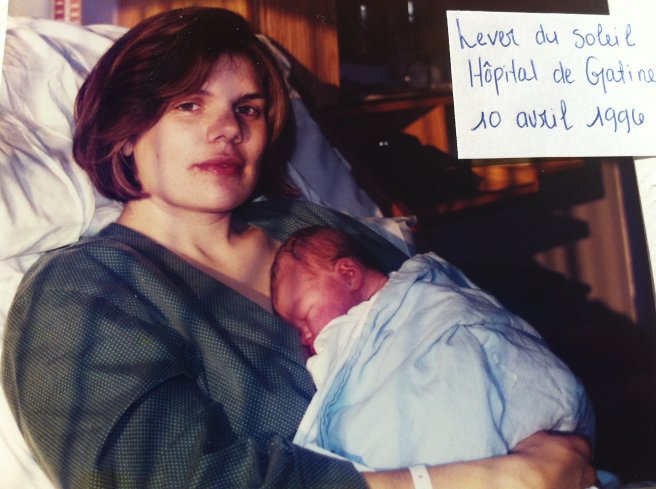
Véronique started writing and illustrating stories in elementary school when she discovered her father’s typewriter. Elementary school was not kind to this quiet introspective child: she became the bane of her teachers’ existence by learning to read before it was permitted. While everyone was learning vowels, Véronique was reading books by Sophie Comtesse de Segur and learning what fate awaited young girls with unbridled imaginations and a lazy streak. This was in the late ’70s in the Province of Quebec where the biggest classroom management issue was precocious readers.

Fast-forward to high school and Véronique is excelling in French, learning English by reading Agatha Christie and failing in math and science. A slow STEM death by a million unanswered questions: “If you were listening, they said, you wouldn’t ask questions.” Véronique graduated high school in 1991 with a diploma, a repressed creativity and the certainty that she was not as smart as people thought she was. She abandoned her dream of becoming a midwife and applied to Law School after getting a College degree in sex, drugs and rock & roll.

Law School conformed to the contours of her brain. For the first time, Véronique saw decent grades appear on her transcripts. To avoid taking Law School for granted {or maybe because she didn’t know how babies were made?} Véronique got pregnant the following summer. And again the following summer. And again just before graduating. In a strange twist of fate, she learned as much about normal pregnancy and childbirth in Law School as do most students in Med School.

In 1995, Véronique punched way above her weight and married the world’s last gentleman. It turned out to be the single best career decision she ever made.

With her law degree in hand, Véronique decided to stay home to care for her three young children. She hung her diploma on a nondescript wall and carried on the anonymous life of the mother of many, adding two more twigs to her fruitful family tree.

We are not sure if Véronique got bored by the quiet with 4 children or if she thought she could get a pee break by finding a real job but she applied for a Master’s in Law with specialization in biomedical ethics while expecting her 5th child and got accepted on her due date. When her infant son was 5 months old, she started commuting from Ottawa to McGill University in Montreal to complete her Master’s degree.

During her time at McGill, Véronique published two Scholarly Articles with Very Serious Titles, including My idea of natural childbirth is ‘no make-up’: {re-titled for publication The ethics of cesarean section on maternal request.} Her practicum were at the Montreal Children’s Hospital neonatal intensive care unit and the Children Hospital of Eastern Ontario neonatal intensive care unit. Her thesis topic was informed consent in neonatal intensive care through the lens of legal pluralism. Or something.

After graduating, she lectured in bioethics at St-Paul’s University in Ottawa and found work as a legislative assistant for a federal Member of Parliament, a job renonwed for requiring no education whatsoever.

Véronique had her sixth child while working as a political staffer. Shortly before the Canadian election campaign of 2011, Véronique got pregnant with her seventh child and accepted a position as her boss’s campaign manager because why the heck not. That’s when the universe thought “Let’s see what she does with that one!” and threw her a curve ball: in the thick the election campaign Véronique found out that she was expecting twins. Babies number 7 and 8 if you are still counting.

Véronique delivered a successful election campaign and won a pair of babies in 2011 {but was mostly noticed for paying more in childcare than she earned on the Hill}. In a spectacular feat of poor timing, Véronique was offered a bioethics consultant position for a healthcare institution in Montreal halfway through her twin pregnancy. She turned down this unique opportunity, fearing that her Master’s degree would end-up being giant money cigar. To avoid being proven right, she started writing a novel based on the adjoining worlds of law and medicine since it worked so well for John Grisham.

In 20-something, and the year after that, {it’s a bit of a blur thank goodness for journalists} Véronique was invited to participate in the Ottawa Human Library Project. In 2014 she gave birth to her 9th child {or so the papers tell her.}

While on bed rest hatching her twins, Véronique started her first personal blog Vie de Cirque (Circus Life), offering the no-nonsense perspective of a mother of many to a small but loyal readership. Vie de Cirque eventually morphed into Fearless Family Life. While her writing and ideas are often complimented, her Internet fame came from spending only $25 per kid on Christmas gifts in 2015 {but not for real}.

Véronique’s most spectacular failures include — but are not limited to — homeschooling her children and crowdfunding her creative work {on both Kickstarter and Patreon} . She came within a tenth of a point of graduating summa cum laude and has never won a single writing competition, including the CBC Short Story Contest. She will likely remain anonymous, remembered by no one but her family as someone who tried, but not quite hard enough, to become a writer. The dog will remember her as the person who fed her. Until someone else does.

Veronique has 9 children, all hers, all from the same father, aged 21 all the way down to 3 and works as a technical writer. She has been potty training for the last 19 years. She still hasn’t it figured out.


Mon héritage


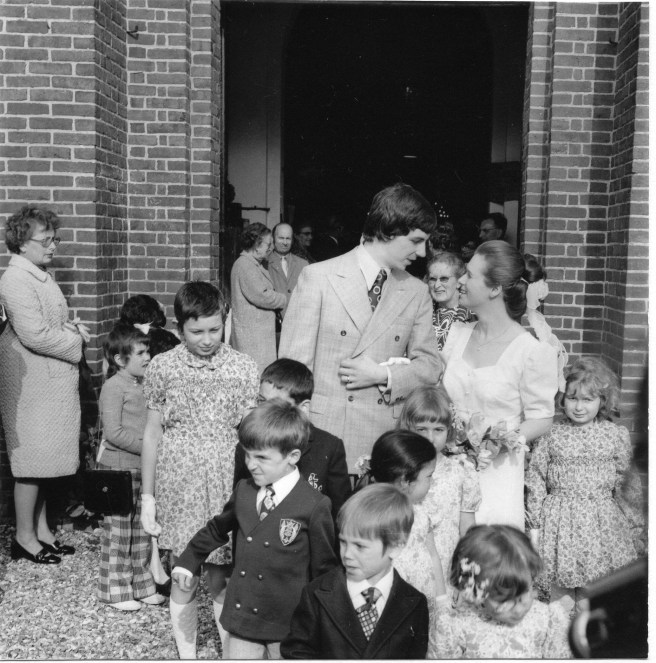
Le 13 mai 2017, mes parents ont célébré leur 45ième anniversaire de mariage. Enfant, je feuilletais leur album de mariage avec fascination. Je pouvais y voir mes cousins, alignés le long du chemin de gravillons qui menait à l’église de Vascoeuil, les garçons portant des vestons assortis, les filles leurs robes à «smocks». Je me régalais de la jeunesse et de la beauté de mes parents. Le complet «Prince-de-Galles» pâle de mon père et sa cravate à motif octogonal criaient 1972. Mais comme si elle voulait conter l’histoire de deux mondes en collision, tout ce que portait ma mère était classique et éternel. Sa robe blanche, confectionnée au Québec par ma grand-mère paternelle,  n’avait autre atour que des petits boutons nacrés mettant en évidence la simple perle qu’elle portait au cou. Ma mère avait délaissé le voile traditionnel pour un chignon élaboré tenu à l’aide d’une large boucle de ruban blanc tombant en spirales le long de ses épaules. Mes parents s’étaient rencontrés aux États-Unis et mariés en France dans le village ancestral de ma mère avant de retourner vivre au Canada, le foyer de mon père. J’ai toujours ressenti un attachement profond à la famille de ma mère et l’album photo de mes parents représentait pour moi une clef du mystère de la dislocation, ce sentiment de n’être à l’aise nulle part, d’appartenir simultanément à deux mondes sans ne jamais se sentir chez soi.

Le jour de l’anniversaire de mariage de mes parents, mes enfants ont annoncé — avec l’aide de Facebook — que mes parents célébraient leur quarante-cinquième anniversaire de mariage. Je me suis exclamé: «C’est impossible! Je ne suis pas si vieille!!», mais non, en effet, je le suis. Je suis née 18 mois après le mariage de mes parents. Aînée d’une famille formée par un francophile et une française, j’ai grandi dans l’ignorance de ma déviance jusqu’au jour où je suis entrée à l’école. C’est alors que mon accent, né du métissage  entre l’énonciation claire des français et le lié chuintant des Québécois — un humoriste québécois a décrit l’accent français ainsi: «C’est comme parler… mais avec des dents.» — m’a valu moqueries, insultes et appels à “retourner d’où je viens.” Mes professeurs me faisaient parler à haute voix pour pouvoir rire de mon accent. Du jour au lendemain mes vêtements choisis d’après les goûts français de ma mère sont devenus démodés; mon imagination créatrice est devenue une perte de temps; ma rêverie est devenue une infraction punissable, et l’humiliation un moyen acceptable de corriger l’affront, de redresser le crochu, d’homogénéiser le bigarré.


J’ai grandi comme «l’autre» dans une communauté québécoise si homogène qu’une petite fille blanche parlant un français différent était perçue comme l’outsider. J’ai grandi au coeur d’une dichotomie où tout ce qui était ridicule à l’école — mon parler, mes vêtements, mon imagination, ma créativité — était célébré à la maison. Le mariage de mes parents, avec leurs univers en collision, avait créé un endroit au sein duquel la différence était saine, voir désirable. J’y prenais refuge contre les moqueries et le rejet de mes amis et professeurs. Le contraste marqué entre l’acceptation artificielle et conditionnelle du monde qui m’entourait et l’amour inconditionnel de ma famille m’a enseigné que les gens qui blessent ceux qui les entourent souffrent d’un mal plus noir et plus profond que les injures qu’ils profèrent.


Le mariage de mes parents n’était pas ce dont on fait les films. Il n’avait aucun artifice, aucune prétention. Portée par l’intrépidité qu’offre la jeunesse, ma mère avait quitté sa famille française au profit d’une vie au Canada, à une époque où les billets d’avion coûtaient à peu près ce qu’ils coûtent aujourd’hui sur un dollar plus difficile à gagner. Les appels téléphoniques transatlantiques se comptaient en dollars par minute. Ma mère nous a élevés sans le soutien de sa famille outre les lettres manuscrites qu’elle recevait de sa mère et de ses soeurs. J’ai vu l’océan s’élargir alors que ses parents prenaient en âge et en fragilité; et devenir plus large encore alors que ses frères et soeurs ont atteint la fin de leur trajet. Mes parents s’aimaient de manière imparfaite, mais ils se sont tenus l’un à l’autre par la force d’une promesse et de leur volonté de céder aux besoins de l’autre.


J’ai toujours compris sans nécessairement pouvoir l’articuler que ma mère avait choisi un mari et non un pays. Elle a toujours cherché à maintenir son identité et sa culture française même au coeur d’une société qui la percevait comme snob ou prétentieuse. On lui disait qu’elle était «gentille pour une française». Presque 50 ans plus tard, elle parle toujours avec un accent français (aux oreilles des Québécois) et n’a jamais goûté à la poutine. Au dîner d’anniversaire de mes parents, mon frère, ma soeur et moi avons fait des farces de bon coeur au sujet de ces «immigrants qui refusent de s’intégrer.» Ma mère a toujours eu un pied dans deux mondes et j’ai toujours su que la famille qu’elle avait créée au Canada était son ancre. Sans nous, elle aurait depuis longtemps suivi les vents d’est vers l’atlantique et flotté jusqu’à la France. Son amour nous était donné gratuitement, mais son coût en était toujours évident.


L’amour inconditionnel est mon arme secrète alors que je suis mon bout de chemin dans le monde d’aujourd’hui. Il m’a été donné par mes parents, inscrit dans chacun de mes gènes. J’y ai trempé dans la douce innocence du sein de ma mère. Je m’y suis accroché lorsqu’enfant je trébuchais. Je m’y suis réchauffée lorsque j’étais seule et frigorifiée. Je l’ai laissé me rapiécer lorsque mon coeur était brisé. J’y ai trouvé le courage de faire face aux moqueries et au ridicule. Je n’ai rien fait pour le mériter et pourtant, il m’accompagne à tout moment.


L’amour inconditionnel est une disposition du coeur qui s’exprime par les mots et les gestes les plus simples. Et pourtant, nous avons du mal à comprendre comment aimer nos propres enfants. Motivés par la culpabilité, nous nous jetons sur tout ce qui brille, que ce soit une nouvelle diète, une nouvelle possibilité, un nouveau trophée. Nous pensons que l’amour devrait être tangible, palpable, mesurable, alors que nous savons très bien qu’il ne peut l’être. Nous arrachons une page du manuel de nos enfants, mélangeant leurs envies et leurs besoins, comme si le besoin de nourriture et l’envie de foie gras étaient la même chose.


Le mariage de mes parents est mon présent et mon héritage. Tranquille et sans prétention, l’amour transforme le monde une famille à la fois.


Just shoot me


“Mom drinking” by Colin

Every once in a while I get invited to give a talk, sit on a panel or chair a board of directors and a request for a headshot inevitably follows. It always feels something less than professional to send my latest selfie but all the other pictures of me were taken my children and involve either my less flattering appendages, booze, or both.

A nagging little voice kept telling me that I should pay for professional headshots but an even less pleasant little voice always answered “It’s not like you’re paid for these gigs, right?” Why should I fork real money to be reminded how old and doughy I’m getting? When there are guitars to buy and live shows to attend?

And so the little voices stood at a standstill on my shoulder until I had to apply for a job using LinkedIn, making my profile selfie my first chance to make a good impression. Chastised, I booked an appointment with a fellow mom and local photographer and started planning my 5 minutes of glamour.

This is what I look like in my head. I feel way cooler than I look.

First, I would get a new outfit. Simple but classy, I had it all figured out: new skinny jeans, a loose-fitting linen tunic with some new jewelry and a new pair of sneakers. Then I would book the few hours before my headshots for a haircut and getting my nails done. My bangs are almost nose-length, it was necessary anyway, and my hair person could style it for me, a skill I was not blessed with at birth. It would be a headshot session doubling as a day of beautification and pampering, the perfect antidote to a sagging spirit. Monday would be clothes shopping day. Tuesday would be eyebrow threading and leg waxing. Wednesday was hair and pictures. Everything blissfully booked while my children were at school.

It all came crashing in a thundering mess on the Sunday evening when I got the photographer’s email reminder. “We’re looking forward to see you tomorrow, Monday June 12th for your session” … I had it all planned out on the WRONG DAY! Right date, wrong day. I had nothing to wear, an overgrown haircut and bushy eyebrows.

In a panic, I hit my oldest daughter’s closet for a dress, any dress. Unfortunately, my oldest daughter, while statuesque, doesn’t have the right curves at the right place. One does not simply carry 9 children to term and expect to fit in a dress from Sirens, even in a size 10. I grabbed some XL shape wear with the desperate energy of the moribund and almost died trying to get it off. Relieved that the jaws of life were not necessary to get me out it, I reluctantly accepted that I was too shapely for shapewear. I grabbed a simple black and white dress from Walmart that made me look as grumpy and unkempt as the Walmart in my small town but at least it covered the right parts and I could take it off without calling the fire department.

The little voice of insanity kept whispering in my ear that Monday morning would not be too late to go dress-shopping. Like a Home Depot ad suggesting “You can do it, we can help.” Like the Scotiabank’s “You’re richer than you think” So many reminders that stupidity could pay off, if only, NO STOP IT!!

On the morning of the photo shoot, I concluded that the only way to avoid a desperate attempt at dress shopping and hair cutting would be to  go to the gym. I could shower and dress at the gym with only minutes to spare for make-up, which should discourage any delusions of grandeur but the most humble slapping of foundation and mascara. On my way out the door to drive the children to school I grabbed a curling iron, a flask of tinted moisturizer and my daughters’ mascara; threw the Walmart dress on top of my gym bag and attacked the day with a significant lump in my throat. The day of pampering and beautification had become just another fight with chaos.

After my workout and shower, my hair was kinked in its usual pony tail shape and I knew I couldn’t beat it so I might as well join it. I arranged my hair in a high pony tail and tried to curl some of it behind my back. I didn’t even know how to turn-on the contraption but maybe I could use it backwards with my arms extended on the wrong side of my head, the one without eyes. Once I found the “on” button, I let the device heat on a ziplock bag of bobby pins. I curled molten plastic into my hair repeatedly before cluing-in, combed it out over the next five days. So far so good.

Undeterred, I whipped my daughters’ new mascara out of my bag. My daughters, while genetically-related to me, have a gift for make-up. It’s a form of artistic expression. See for yourselves.

Is that a brush or a weapon? It depends on who wields it.


If your main consideration when choosing mascara is “can this brush maim me permanently?” you shouldn’t borrow it from my daughters: they’ve been using it without poking their eyes out since grade 1. This was my reflection as I beheld the sickle-shaped, black-paint laden, rigid object I was about to take dangerously close to my eyes.

I emerged from the gym’s change room with a “this is my normal face” attitude, hoping that no one had seen me wipe melted ziplock off my curling iron, and stepped into the car for a mad drive across town. I knocked on Sara’s door taking my first breath since breakfast and greeted her with an executive summary of my confusion and the effort exerted to get my butt into her studio. She laughed and said “On the other hand, this is exactly what you look like in real life. Sometimes I meet people at business events and I don’t recognize them from their headshots.”

She’s right isn’t she? I don’t wear make-up because it bugs me. I don’t have nice clothes because I hate shopping. I’d rather spend my time writing, playing music and answering emails about parenting struggles and victories. I’m not at an age and stage where I can  look polished and be a decent human being at the same time. Every morning, I choose being present and un-rushed to being properly dressed and styled because being-both-level has not been unlocked yet. This is who I am.

And this is exactly what I look like.

Photo creds: Sara McConnell Photography http://www.saramcconnell.ca/


The gift of unconditional love


On May 13th, my parents celebrated their 45th wedding anniversary. As a child, I remember looking at their wedding album with fascination. I could see my older cousins as children, lining-up on the Church’s gravel path as flower girls and pages: the boys wearing matching suits, the girls wearing handmade smocked dresses. I marveled at my parents’ youth and beauty. My father’s light-coloured plaid suit and his honeycombed tie screamed 1972 but almost as to tell the story of two worlds colliding, everything about my mother was timeless and classic. Her white dress had no adornments but round pearl buttons complementing the single pearl she wore around her neck. She had eschewed the traditional veil for a tasteful updo, held together by a wide white bow falling in loose coils down her shoulders. My parents had met in the United-States and were married in France in my mother’s hometown before moving to Canada, my father’s home. I always felt a strong attachment to my mother’s homeland and my parents’ wedding album was a key to the mystery of dislocation, of never feeling settled, of belonging to two worlds and, at the same time, never being home.


On their anniversary, when my children announced — upon checking Facebook — that my parents were celebrating 45 years of marriage, my first exclamation was “This is impossible, I’m not that old!” but sadly, yes, I am. I was born 18 months after my parents’ wedding. Firstborn to a francophile and a Frenchwoman, I grew-up in the blissful ignorance of my deviance until I started school. There, my lovely accent, a bastard of France’s clear enunciation and Quebec’s slur — one Quebec humorist once described the French accent as “speaking French with teeth” — attracted taunts, laughs and calls to “go back to where I came from.” Teachers would ask me to speak just so they could laugh. My family’s fashion sense, always tasteful and timeless, became old-fashioned. Creativity became delusion, daydreaming was a punishable offence and public shaming an acceptable mode of righting the wrong, straightening the crooked, homogenizing the colourful.

I grew-up as “the other” in a community that was so overwhelmingly White-French-Canadian that the white France-French kid was considered the outsider. I lived in an interesting dichotomy where everything that was ridiculed at school — my speech, my clothing, my imagination, my creativity — was celebrated at home. My parents’ marriage, with their worlds colliding, had created a place where being different was safe, even desirable. It was a safe-haven from the rejections and mockeries of my friends and teachers. The stark contrast between the artificial conditional love of the world and my family’s unconditional love was a school in the pain that lies in the hearts of hurtful people.

My parents’ marriage wasn’t the stuff movies are made of. It had no artifices, no false pretences. Buoyed by the intrepidity of youth, my mother had left home and family in Europe for a life in Canada at a time when plane tickets had roughly the same face-value they have today on a dollar that was a lot harder to earn. Long-distance phone calls across the Atlantic were priced in dollars per minute. My mother raised us without the support of family, save for the regular handwritten letters she would get from her mom and sisters. I saw how the ocean grew wider as her parents grew older and sicker; and wider still today as her siblings are reaching the end of their journey. My parents cared for each other in ways that were not always perfect. But they held each other by the force of commitment and the willingness to make way to the needs of others.

I always understood without being able to articulate it that my mother had chosen a man, not a country. She struggled to retain as much of her French identity as she could in a society where it was viewed as snobbish and pretentious. She was called “nice, for a Frenchwoman.” Almost fifty years later, she still speaks with a French accent and has never tasted poutine. At my parents’ 45th anniversary dinner my siblings and I cracked jokes about the poutine story, shaking our heads about “those immigrants who refuse to integrate…” My mother still has a foot in both worlds and I always knew that her family, the one she had made in Canada with my father, was her anchor. Without it, she would float away eastward to the Atlantic and over back to France. Her love was freely given, yet its cost was always in plain sight.

The gift of unconditional love is my secret weapon as I move through the world today, raising my own family. It was given to me by my parents, inscribed in my DNA. I soaked in it in the quiet ignorance of the womb. It caught me when I tripped as a toddler. It wrapped its arms around me when I was cold and alone. It patched me up when my heart was broken. It reassured me when I was mocked and ridiculed. I did nothing to earn it and yet, it weights on every aspect of my life.

Unconditional love is a disposition of the heart expressed in the simplest words and actions. Yet, we struggle to understand how to love our children. Driven by guilt we grasp at anything that resembles unconditional love whether it’s a new diet, a new opportunity, a participation trophy. We need to make love tangible, measurable, when we know, deep down in our innermost heart, that it cannot be. We rip a page from our children’s playbooks, confusing their wants and needs, unable to separate the wheat from the chaff, as if the need for food and the want for organic local food were one and the same.

My parents’ marriage is my gift and my inheritance. Quiet and unassuming, love changes the world one family at a time.


The post below is password protected. Find out why!


Hey everyone! Thank you for reading and thank you for being there. You will notice that my previous post is password protected. That’s because it is exclusive to my Patreon supporters. To have access to it, please consider making a small monthly donation in support of my writing and podcasting efforts. A single dollar a month will do (although you are allowed to give more.) Please visit my Patreon page to find out how you can support Fearless Family Life: https://www.patreon.com/user?u=4218396


I got pregnant in university


43950257_10156569090891278_3450319568734519296_n

I got pregnant with my first child at 21, during the summer following my first year of law-school. I remember walking to the pharmacy in a daze. The pharmacy ran pregnancy tests for $7. That was half the price of the home pregnancy kits!! I soon understood why anyone would prefer paying the extra $7 to get a pregnancy result in the privacy of their bathroom. The pharmacist said: “It’s positive.” I said: “Positive means I’m not pregnant right?” But I knew. I had seen my busty profile in the window of the pharmacy walking-in. I knew for sure.

Despite a few tell-all signs of pregnancy, I had visited a walk-in clinic a few weeks earlier asking for a throat swab. I thought I had strep throat because I was craving popsicles and I was always on the verge of throwing up. I told the doctor: “I have cramps, my periods are 2 weeks late, I’m nauseous all the time. Could this be strep throat?” So he did what any doctor with a clue about the birds and the bees would do: he took a throat swab. That test was negative.

As I was walking out of the pharmacy, I was counting the months on my fingers to see if I could finish my second year of law school. I was due April 17th, during exam week. Well, it wasn’t that bad I thought, I’ll be able to finish my year and write my exams.

I went through my second year of law school pregnant. I was sick as a dog. I have two vivid memories of doing law school pregnant: one where I am uncomfortable, sitting in the lecture hall’s plastic chairs. My regular pants are getting too small. They are riding up my legs and digging into my waist. This is after Christmas, I am almost 20 weeks pregnant and thinking I will either buy pregnancy clothes or kill someone. In the other memory, I am wriggling my way across an entire row of plastic chairs during a lecture on civil proof to go throw-up. I made it.

IMG_2699

I made arrangements with the Dean to write my exams after my due-date. I thought that writing exams 3 weeks postpartum would be better than 40 weeks pregnant (pro-tip: it’s not). On my last day of classes, I took the bus back home and someone asked me: “When are you due?” I said “Next week.” That evening, I went to the hospital in labour. My daughter was born with the sunrise the next morning.

What would I say to the young woman finding herself pregnant in the middle of her university education? First, you can do it. It won’t be easy but you can do it. Don’t expect understanding, a red carpet or a special parking pass. You will be facing harsh judgement coming from your peers, your teachers and the administration. Few people will give you favours unless they have to by statute or regulation. Remember those who go the extra mile for you: someday, you will extend the same generosity to someone else.

You are pregnant now, soon you will deliver. Delivering a child will give you a sense of perspective, a new understanding of what truly matters. Being a mother will empower you. This feeling of empowerment will seep through every aspect of your life and give thrust to your studies as you face the challenges at hand. You will take that Queenship of the Universe with you back to University and beat the crap out of your degree.

You will face harsh and underserved judgement. Some people think that getting knocked-up is never an accident, that you should have known better. Some people will not know what to say in the face of an unplanned pregnancy. Many people will look at you with a mix of contempt and pity and ask: “You’re not keeping it are you?” as if you would be announcing a pregnancy you were about to end. Some women, and that’s what took me the longest time to accept and understand, will be angry at you. They will shun you for putting a face on something they thought was impossible. In hindsight, I have accepted that these women were suffering more than I was. But it was so hurtful at the time, feeling like pregnancy made me a leper, an uncool, an outcast. Know that this will not last. For the community of cool that you are losing, there is an equally sleep-deprived — if less fashionable — community of parents ready to embrace you.

You will come out smarter on the other side. You will be working harder when it’s no longer just your ass on the line. You think you will have less time with a baby on your hip but don’t underestimate the time it takes your peers to manage their social life. Motherhood will focus you and give you a new appreciation for what matters: both in small and in big things. You will focus on the essential and perform with surgical precision. You will start your end-term papers as soon as you get the course outline and write 2 pages a day until it’s done. End-term all-nighter cramming sessions are a thing of the past. You will work around it and discover a better, more mature way. Baby will force you to take breaks, sometimes entire days off, and your brain will thank you in your report card.

You and your priorities will change. Don’t sweat the student stuff. I wasted so much mental energy worrying about my inability to take part in moot-court competitions, out-of-town placements, student exchanges and fancy articling jobs in the best Montreal firms. In the end, I graduated with no desire to join the law firm rat race. I oriented my career on a different path. And that’s ok.

Try not to get caught-up in the latest baby gear must-have and other parenting fads. They are costly and unnecessary. A baby’s needs are simple: babies need care and affection. Breastfeed, sleep in the same room, buy a second-hand stroller and a good baby carrier. At some point you will need a second-hand high chair. Financially-speaking, I was fortunate to have a boyfriend-now-husband who had a stable job as a junior military officer: our income was small but reliable and my parents were taking care of my tuition. It will be difficult enough to make ends meet without trying to keep-up with the older, richer, Joneses.

Finally, don’t get angry if academia doesn’t give you any freebies. Just deal. Be a honey badger. The workplace won’t give you any freebies, so you might as well get used to it early.

43787707_1850678055051831_1019106434085814272_o54524025_1115336158667436_8781332276173602816_o

The skinny on the Whole 30 challenge


Two of my girls — the first girl I gave birth to and our nanny — embarked on a Whole 30 challenge at the beginning of March and successfully completed it today. As the family cook and principal grocery shopper, I am equally proud and relieved that it is finally over.

I’m proud of them because it’s one thing to do the Whole 30 in all its restrictive goodness when you are fat, middle-aged, and suffering from a host of chronic conditions; it’s another thing to do it when you are young, healthy and beautiful with not a single pound to lose.

Clara and Hannah, 3 weeks into their Whole 30, looking as stunning as ever.

I have to bear some responsibility for switching my family on to the Whole 30. In December 2014 I hit the proverbial wall and on a friend’s recommendation, with my husband’s support, I went for it.

I have always been able to lose most of my baby weight — slowly — in between pregnancies. I am the proud owner of a metabolism that doesn’t gain weight easily and doesn’t lose it easily. For my first 7 pregnancies, I would gain 30 lbs while pregnant, lose 10 giving birth, gain another 10 while breastfeeding and eventually shed it after weaning. After the twins were born, I went on Weight Watcher to lose that pesky 20lbs because it wasn’t coming off on its own and that’s when my health went pear-shaped. As soon as I restricted calories, I started gaining weight. That spurred me into more restrictions, believing — as I was told all my life — that the only reason one gains weight is because more calories go in than come out. So I cut back, and I gained weight. I ran longer distances, and I gained weight. I became anemic, and I gained weight. I counted how many carrots I ate with my tablespoon of hummus and I gained weight. I realized that an avocado was as many calories as a double chocolate chip muffin. I stopped eating avocados and I gained weight. I replaced sugar by Splenda in all my baking and I gained weight. And every week, the Weight Watcher app would tell me:

“Ooops, you gained. You’ll try harder next week.”

I tried some more and I gained some more. I had my thyroid checked and was told it was normal (it wasn’t but that’s a whole other post). I was discouraged and overwhelmed. I felt guilty every time I ate something I enjoyed.
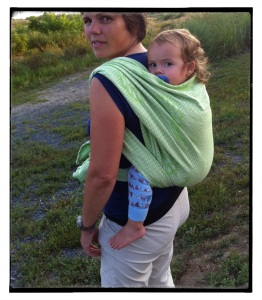
Then I got pregnant with Damien. And I gained A LOT of weight. A month after he was born, I weighed as much as I did when I was 38 weeks pregnant with the twins. I went back on Weight Watchers when he was 7 months-old. I gained 11 lbs in 6 weeks. My husband, who is really the most supportive husband I have, told me: “There is something weird happening with your body.” Seeing myself in pictures at Christmas made me cry. I lost sleep over my ballooning body. I was always on my feet, I ate well, I was making breast milk for two children, one of them exclusively breastfed. Then I saw my You Tube babywearing video, with my size 8 jeans, and I almost broke down.

9 months before Damien was born, newly pregnant, weighng about 145 lbs. Today I can’t even lift those pants past my generous thighs. But I keep trying….


9 months after Damien was born, weighing almost 200 lbs. Just before I started my Whole30.

I told my husband: “I am almost 200 lbs! I just need to stop gaining! I know I won’t lose much while breastfeeding but the gain must stop!” I was no longer fitting in my pyjamas. I had gone from a size 6-8 to a size 14 while doing Weight Watchers and the best my doctor had to offer was:

“Maybe you’re cheating on your food journaling.”

You went to med school for how long so you could tell me that? It was clear to me that the problem was not “how much” I ate but “what” I ate. I didn’t eat too much; I knew that from years of food journaling. The story couldn’t only be about my caloric intake. I watched this video about the effect of sugar on our metabolism and I reduced my sugar intake. That’s when I stumbled upon a friend’s testimony about the Whole 30: 30 days of strict no added sugar, no grains, no legumes and no dairy. I thought: “No way!” but the idea kept nagging at me. I knew that I couldn’t moderate my refined carbohydrate intake: I needed to punch my carb demon in the throat.The Whole 30 is not a lifetime commitment to never taste a brownie again, it’s a chance to reset your eating habits, to give more emphasis to good food and keep the less healthy stuff in proper proportion within your entire diet. It is not presented as a weight loss diet or a cleanse, but as a tabula rasa, a baseline from which to start eating well again.

On January 1st 2015, I started my Whole 30 and completed it successfully 30 days later. Other than accidentally licking a spoon of oatmeal I was making for my children, I didn’t slip. After my Whole 30, I didn’t return to my old eating habits. I still eat 80% paleo and 100% gluten-free. I allow myself milk chocolate treats, milk in my lattes when I’m not at home and occasional gluten-free baked items. I have since been diagnosed with Hashimoto’s Thyroiditis, an autoimmune condition that explains a lot of my weight gain, fatigue, and depression issues.

Since doing the Whole 30 and switching to a sort-of Paleo diet, I have noticed some positive changes in my overall health. On the whole, It has made my autoimmune condition easier to manage. Here is a bullet-list of my observations, in no particular order:

– I am much more alert during the day, especially when driving. I used to have a major slump mid-afternoon which caused me to fall asleep at the wheel. I no longer suffer from these attacks of daytime sleep. As someone who spends a fair amount of time driving young children on lonely country roads in winter, this is a welcome improvement.

– I am awake in the morning (but this might be due to a switch in my migraine meds). Still. My 5 youngest children hit the ground running at 6am sharp. It used to take me an hour or two to catch-up with them. Now I wake-up awake. I don’t want to get out of bed at 6:00am but I can.

– My night sleep is still crappy. I only ever sleep with one eye open. I am never deeply asleep. I had great hopes that the Whole 30 would address this but it hasn’t.

– My sugar and refined carbs craving are gone. At least they don’t control my life anymore.

– I have discovered the natural sweetness of food. I find almond butter sweet. I find the taste of blueberries to be an explosion in my mouth. I really appreciate the food that I eat.

– I rediscovered the sense of smell. When my friend came over with her award-winning brownies, I found that having a deep smell of them was satisfying. The smell fills your nose and mouth and your brain gets a little kick, just enough to be able to walk past them without having to eat them at all cost. My husband thinks I have a problem sniffing croissants but I think it’s awesome that I don’t feel compelled to EAT ALL THE PASTRIES (ALL THE TIME).

– I don’t feel like the pastries in front of me are the last ones I will ever have. That’s a big one. I always indulged in whatever pretty sweet things were in front of me because I had a scarcity mindset about food, even though I have never gone lacking. I think it was due to the addictive nature of sugar and refined carbs. I felt driven to indulge. And if I didn’t indulge, my mind would stay stuck on the food items. Now I feel in much better control of my eating.

– I don’t want to eat all the time. I can easily go between breakfast and lunch without a snack. I don’t even think about eating unless I am really hungry.

– When I am tired in the evening, I want to go to bed, not eat a gallon of ice cream. My body is better able to read its own signals without reverting to “EAT” automatically when it needs rest, exercise, fresh air, water or relaxation.

– Because I’m not always lusting after food or ravenously hungry, it’s easy to skip meals or snacks. I don’t get irrationally grouchy when I have to go without food.

– And from the TMI files: it really helped with my menstrual cycle, making my periods less debilitating. Although PMS perfection has come from properly diagnosing and treating my thyroid condition.

– I drink my coffee black and it no longer tastes like death warmed over.

– I have been struggling with generalized pain all my life. Tests performed in childhood and as an adult were always inconclusive and the pain remained. The Whole 30 helped a lot with pain but didn’t make it go away completely. A food intolerance panel ordered by the doctor who was investigating my thyroid dysfunction revealed that I had an intolerance to eggs and corn (among other things). Cutting the right foods from my diet has made a huge difference in my generalized pain. I saw a physician specialized in body mechanics (a physiatrist) who told me that while there was little scientific evidence linking generalized pain with diet, she saw it all the time in her practice. Especially as it concerns dairy and gluten.

– And the big question: did I lose weight? Not a whole lot. I lost 12 lbs doing the Whole 30 but I was still firmly a size 14 until I started weightlifting in summer 2016. I lost another 10 lbs when I started training. Now I’m somewhere between a size 12 and a size 10 and I haven’t lost a single pound in a year despite eating well and exercising with a personal trainer. At 180 lbs I’m still ways away from my personal “normal” of 135-140lbs but honestly, I have (almost) accepted the fact that I have done everything humanly possible to lose this wretched weight. Thanks for nothing, thyroid jerky.

Whole 30, before and after. I went from 190 lbs to 178 lbs. I was not exercising at the time.


Podcast 010: Mixed greens on giving, schooling and standing your ground when your favorite band is playing


My new podcast is up and ready to listen. In episode 10 of The Véro Show, I reflect on giving away things we still (think we) need, how my children are doing in school, and knowing when to say yes and when to say no to commitments.

0:00:30 – Intro and new patrons shout-out
0:07:30 – Giving until it hurts
0:18:00 – How my children are doing in school
0:34:00 – The Lumineers show and standing up for oneself by literally standing up.
0:43:00 – What if I don’t want a mediocre life?
0:52:00 – Prioritizing our commitments to get out of the “tyranny of the urgent.”