In which I tell you how I really feel about homeschooling


When I started homeschooling, I encouraged myself by thinking that I wasn’t the first one to do this. Not the first one to homeschool with an infant. Not the first one to homeschool with toddler twins. Not the first one to homeschool with a large family. Not the first one to homeschool 4 different grades. Not the first one to homeschool kids who don’t want to homeschool. Not the first one to homeschool outgoing, extroverted kids with two volumes settings: loud and louder. Not the first one to homeschool children with a lot of energy and big feelings. Not the first one to homeschool with a husband who works long hours and cannot help with homeschooling. Not the first one to homeschool without my family’s support. Not the first one to homeschool in a language other than English. Other people have done it, right? So it has to be possible. Well, I’m not so sure anymore!

It’s getting lonely at the top. I see people quit homeschooling every week for one of the reasons I listed above. And when I hit the Internet looking for help, I find people with any combo of one or two of my challenges but never all of them. There’s Sarah from Amongst Lovely Things who has toddler twins and recommends lowering expectations. But expectations can only be lowered so much when you are homeschooling highschool. We lowered our expectations so much this year, we nearly dug a hole to China. I wish I could curl-up on the couch and read to everyone from the grade 10 chemistry text book but THEY WON’T STAY SEATED!

And then there’s the lovely — lovely! — Kendra from Catholic All Year who has a large family and gets by being pregnant, breastfeeding and homeschooling by having naps and exercising. And how do naps happen? By putting the baby and the toddler down for a nap at the same time and then giving the other children a quiet activity to do. This makes me want to cry. My almost 4 year-old twins have not napped since they were 2-and-a -half and a quiet activity for the  four youngest means that I have to physically restrain them, usually by sitting on one and keeping the door closed on the other. It’s great. We have a quiet time daily to the sound of children howling “HOW MANY MORE MINUTES?” every 30 seconds. My husband thought I would feel better if I exercised so we started getting up at 5 am — because that’s how early we have to wake-up if we want to wake-up before the kids. Since we have teenagers who are up until 11 pm, it gives me 5 interrupted hours of sleep on which to keep my wits, my household and my homeschool running smoothly. It gives a brand new meaning to the quip: “I’m in no shape to exercise” believe it or not.

It’s not that I’m jealous of people who have children who are temperamentally disposed to sit down and stay quiet. After all, my four oldest children were pretty easy. But it does make me realize that homeschooling is not going to be easy for us and sometimes I’m a big baby and I shake my fist at God and say: “If you were going to call me to large familyhood, why couldn’t you have sent me the kids who slept in my fourties instead of my twenties??” (then God laughed and sent me twins who didn’t sleep for 15  months and stopped napping at 2.)

And then there’s Julie from Creekside Learning who has a ton of great suggestions for homeschooling with a busy toddler underfoot. Julie adequately describes my life when she writes:

But when he was not-quite-two, I typed “how to homeschool with a toddler” into a search engine and found things like this:  “Give your child a copy of the worksheet your older child is doing so he will feel included.”  That was good advice but it was just not going to work with my super-active, sweet boy. He was the kind of toddler who tore up worksheets with his teeth, spit them out and looked at me like “What else ya got?”

Julie makes realistic suggestions for the mere mortals but she has 3 children total and I have 3 children *under 4*. And 4 different grades to teach. And 11 people to feed. And a house to keep from getting shut down by public health authorities. We can’t explore our way through algebra outdoors by counting puddles and spiders. Homeschooling at odd hours is impractical for the elementary school aged children who are tired after the twins are in bed and having a slack year will only work as long as it’s an exception, not your way of life (see “homeschooling highschool” above.)

(As I was writing this, I saw Ève apply something to her face from the corner of my eye and I asked “What are you doing?” She answered: “Putting my make-up.” I asked “With what?” She replied: “Butter.”)

There are so many “turn key” homeschooling curricula allowing lucky parents to crack the books open and let the magic happen. Some even have teacher assistance and tutoring. But all these wonderful options would require us to give-up on French instruction. So I’m still here, fighting my way through a makeshift French curriculum while guarding the fridge and making sure the twins don’t set the house of fire. My homeschool days start early and end late and my kids are even less thrilled about homeschooling then they were when we started (which brings the enthusiasm level down to “cadaveric”). Onward and upward!

Are we going to keep homeschooling in light of this difficult first year? In a nutshell, yes. For all the difficulties that we have faced, we have also seen positive changes in our children that we want to see blossom. I can see that the challenges associated with parenting 3 year-old twins are temporary and age-related. I can also see that many of my challenges are due to learning to homeschool and the process of “deschooling” . My teenagers are still affected by the homeschooling stereotypes they have heard while attending school, especially in the year prior to our move to homeschool. They are also not as independent and autonomous as they would be had they been homeschooled from the start. Part of my problems with homeschooling — and the reason why other homeschoolers with large families have better success — is that I have children who should be old enough to work autonomously but don’t. When my teenagers run our of work or encounter a problem they cannot solve, they revert to school mode and stop working. This means that all 7 children present at home during the day need me to be physically present by their side while working or living. That’s not a normal occurrence in large homeschooling families unless they have children with special needs. My children, especially my teenagers, have yet to take responsibility for their learning and their socialization. They are quick to criticize what I throw at them but in true school manner, have not clued-in that they can affect change by getting involved. There is still too much room for improvement to call it quits at this point.

I always tell parents that they need to raise their children with the end-game in mind. When I look forward, I like what I see. I can imagine the fruit before it matures and the fruits of homeschooling are the ones I want to harvest.

(As an aside, if you have suggestions that don’t involve hiring a butler, a maid, a driver and a governess, feel free to shoot them my way.)


Answer me this: Home Sweet Home


“Answer me this” is a bloggy cocktail party hosted by the lovely Kendra from Catholic All Year. We get to answer 6 random questions and chat about it. This is my first stab at it. I have to admit that not having to come-up with a writing topic is oddly linerating. Here I go!

1. How long have you lived in your current home?

6 months.

Last December, we moved to the boonies of the sticks after designing and building our own large family home. (Edited to clarify: by “large family home”, I mean that the family is large. I’m not bragging about the size of my house. Got it?) Our little piece of Canadian Shield sits somewhere in the Ottawa Valley, in Ontario, Canada. We are still learning to unlearn our city ways. Our children’s reaction to the move has been — ahem — mixed, with the old and the new being very excited and the middle being ambivalent, bordering on P.O.’d. There’s never a good time to move a 15 year-old and since we’ll have a 15 year-old for the next 20 years, we figured now was as good a time as any. 


Specimen of a teenager not happy to live in the country, plied with ice cream .

Living on the outskirts of light pollution has given our oldest son plenty of opportunities to dabble in low light photography. Here is the Milky Way over our house:

Hat tip to our oldest son Colin IG: @colin_deg

2. How do you find out about news and current events?

Mostly through social media (Facebook and Twitter) and CBC Radio 1 in the car. When I don’t have to listen to Taylor Swift. 


“NOT THE NEWS!!!'”


My husband is a great consumer of news and current events, especially when it concerns food, water and energy issues, and the unravelling of the European Union. He often sends me email links to articles he found interesting.

3. Would you be able to make change for a twenty right now? For a dollar?

Right now? No because I ran out of cash this week. But usually yes, for either. Our family had a run-in with excessive debt a few years ago that spurred a series of changes to the way we manage our life and our money. Those changes eventually led to our move to the country. We now operate on a cash-only basis and use money envelopes, like 8 year-olds. I can usually make change for a $20 but now my envelopes are empty until tomorrow. Sorry.

4. What’s the craziest food you’ve ever eaten?

I still don’t know! I think it was some kind of congee . We were traveling back from Niagara Falls and visiting the Toronto Zoo. We booked a hotel room in Markham and left the hotel to eat our evening meal. Everything was written in Chinese! All the strip mall signs. All the restaurants names. All the menus. We had no idea where to go and eat with our 6 children so we parked in the middle of a strip mall parking lot and kept our eyes peeled for a family going into a restaurant. As soon as we saw someone walk in a restaurant with a child, we made a beeline for the same restaurant. The menu was in Chinese and our waitress spoke as much English as we spoke Chinese. We were thrilled! We don’t really know what we ordered or how much but eventually the food started rolling-in and we started eating. At one point, we received this sort of gruel, wrapped in a large leaf and obviously containing some fish entrails and other delicacies. Even with our adventurous palate, we weren’t able to give it the honor it deserved. We had also ordered way too much food. There’s only so much chucking of unknown fishy gruel you can do on a very full stomach. 

Many years later, when my friend Johanne went to Viet-Nam to get her son Toan, he was so malnourished that getting food into his frail little body was a work of every instant. Johanne posted on her blog that Toan really liked congee and that the hotel chef was showing her how to make it for him. When I googled “congee” there it was!! My mystery dish! 

Sadly this was before phone cameras and Instagram and I don’t have a picture. Instead, here is a picture of Eve’s dish: blueberries and rice with Bragg’s. What??


5. Which of the commonly removed parts have you had removed? (tonsils, wisdom teeth, appendix, etc.)

For a blogger, I have this thing about sharing medical information on social media. You can get my kids’ faces but not their medical histories. Because who knows? Who knows when their insurance company in 25 years will unhearth that blog post and say “Here your mom writes that you spent 2 days in NICU as a newborn and you had trouble breathing, so we’re not covering you for any lung-related illnesses”. Know what I mean? Same goes for me. I blame the graduate studies in biomedical ethics. 

What I can tell you is that I lost 9 placentas over the years. Does that count? 

umbilical cord for miles following one of our home births

6. What’s your favorite sport to watch on TV? 

We don’t have cable so that takes care of sports watching on TV. We do watch a lot of gymnastics competitions on YouTube and Dancing with the Stars if there is a gymnast in one of the teams. 

My husband and I are not snobs about many things but I have to sheepishly admit that sports watching on TV is one of those things. We just don’t get it. 

We prefer doing sports to watching it. Sometimes we do both.

La discipline sans menaces 


Lorsque j’ai commencé à éduquer mes enfants à la maison, j’ai rapidement remarqué un rétressissement marqué de mon espace vital. Mes enfants étaient omniprésents. Soudainement, nous étions ensemble toute la journée. Et la soirée. Et la fin de semaine aussi. Il nous fallait apprendre à vivre ensemble et à respecter l’espace de chacun. Pas une tâche facile dans une famille grand format.

Le respect de l’espace vital de chacun ne se fait pas qu’au plan physique: il faut aussi apprendre à se traiter avec respect minute après minute, heure après heure. Je dis souvent à la cantonade qu’il est impossible d’élever des enfants sans pots-de-vin — et je ne parle pas d’un verre de rouge après l’heure du coucher — mais pour plusieurs d’entre nous, les menaces plutôt que les promesses sont la pierre angulaire de notre approche disciplinaire. Sur les forums Internet que je fréquente, les approches basées sur les menaces ou le retrait de privilèges foisonnent. Pendant longtemps, j’ai souscrit à ces approches, préférant faire référence aux “conséquences” d’une action plutôt qu’à une punition.

J’ai rapidement appris que nos jeunes enfants (et même nos adolescents!) n’avaient pas assez de contrôle sur leur environnent pour que notre approche disciplinaire puisse reposer sur les conséquences naturelles d’une action. Pensez-y. Un enfant joue près du four, un enfant désobéi et va jouer dans la rue, un enfant mord un autre enfant. Les conséquences naturelles de ces actions sont physiquement ou emotivement inatteignables. Qui va laisser son enfant se brûler sévèrement ou se faire frapper par une voiture par acquis de discipline? Et pour la morsure, les remords et la perte d’un ami sont à plusieurs années de faire une différence. Il arrive souvent aussi que les conséquences naturelles soient trop onéreuses pour la famille ou se résument à punir toute la famille pour les actions d’une petite personne. C’est le cas lorsque nous promettons à bout de nerf d’annuler Noël, un voyage à Disney ou de quitter le resto sur le champ. Nous devons tous nous rabattre sur des conséquences inventées pour faire une impression: retrait de privilèges, isolation, confiscation de jouets, privation de dessert.

Cette approche a plus ou moins de succès selon le tempérament de nos enfants et le notre évidemment. Certain enfants choisiront toujours la “conséquence” histoire de garder le contrôle sur une situation qui leur échappe. Certains parents passeront rarement aux actes histoire d’éviter un face-à-face explosif. L’appel aux conséquences est d’une utilité limitée, surtout lorsque celles-ci sont inventées et doivent être mises-en-œuvre par les parents. L’utilité des conséquences naturelles est leur renforcement naturel, sans avoir recours aux discours, à la répétition et à la punition. La conséquence inventée (par exemple, range ta vaisselle sale ou perd ton tour de PS3) doit être imposée par le parent tout comme les mesures punitives. C’est donc une punition déguisée en conséquence.

Un autre problème avec le recours aux menaces et à la perte de privilèges, particulièrement dans le contexte de l’instruction en famille, c’est que la plupart de nos enfants mènent une vie dans laquelle le privilège est partie intégrante, c’est-à-dire qu’il est difficile d’isoler le privilège pour pouvoir l’enlever. Au jour le jour, une fois que nous avons retiré le privilège d’écran ou le dessert, peut-être une sortie chez un ami ou une fête d’anniversaire, on arrive à bout de munitions. Mes enfants perdent souvent leur privilège de télévision ou leur iPod avant 9:00 du matin. Lorsqu’on manque de “conséquences”, on doit se rabattre sur notre autorité toute simple. Et c’est ainsi que je me suis rendu compte que mon autorité, sans menaces, était plutôt mince.

C’est ainsi que je me suis embraquée dans un défi de discipline sans menaces.

J’imagine que vous attendez que je vous admette que tout marche à merveille ou que tout a foiré? Ni l’un ni l’autre. C’est une aventure à long terme. Mais je peux vous dire que nous avons beaucoup de chemin à faire avant d’arriver à un résultat tangible. La discipline interne est le travail d’une vie, si j’en crois mon expérience.

Le rodage ne s’est pas fait sans frictions. Libérés du contrôle artificiel qu’imposaient les “conséquences”, la fratrie est graduellement tombée dans le chaos le plus total. Le travail d’école est tombé en friche et le niveau de criage, d’insultes et de chamaillage ont atteints un nouveau record (ce qui n’est pas peu dire). Mon autorité ne tenant qu’à un fil, je suis devenue irascible, impatiente et généralement irrationnelle. La conclusion de mon expérience de discipline sans menaces était déprimante d’une manière ou d’une autre: soit je devais remettre les menaces au menu, soit je devais me déclarer vaincue et à la merci de mes enfants.

Avec un peu de recul et de réflexion, j’ai réalisé que le recours aux menaces me permettais de ne pas imposer de limites strictes, d’encadrement ferme. Une fois au bout du rouleau, je n’avais qu’à brandir  le retrait de privilèges pour que les choses se placent. J’ai appris que sans menaces, je devais être beaucoup plus claire et prévisible quand il en venait aux attentes et aux limites. Éliminer les menaces me forçait à être à la fois plus tendre et plus ferme. J’ai du établir des règles de conduite dans la maison — autant au niveau du comportement que de l’espace physique — que je dois faire respecter sans exception sous peine de me perdre dans l’anarchie. D’une certaine manière, c’est un style de vie plus restrictif qu’avant mais j’ai espoir qu’avec un peu de temps et beaucoup de pratique nous allons arriver à un point d’équilibre. En somme, j’essaie d’être moins “réactive”, c’est-à-dire que je n’attends pas d’être en face d’une situation critique avant de réagir. J’essaie de ne pas me rendre au bout du rouleau. J’y arrive en ayant recours aux routines et aux séquences, en baissant le volume pour garder le calme et en n’ayant pas les yeux plus gros que la panse au niveau de la discipline. Je prends un bouchée à la fois, un changement à la fois, et je mâche et remâche jusqu’à ce que le morceau soit passé.

Heureusement, j’ai l’occasion de pratiquer souvent!


Discipline sans menaces 


Lorsque j’ai commencé à éduquer mes enfants à la maison, la première chose que j’ai remarquée fut l’omniprésence de mes enfants. Soudainement, nous étions ensemble toute la journée. Et la soirée. Et la fin de semaine aussi. Il nous fallait apprendre à vivre ensemble et à respecter l’espace vital de chacun. Pas une tâche facile dans une famille grand format.

 Le respect de l’espace vital de chacun ne se fait pas qu’au plan physique, il faut aussi apprendre à se traiter avec respect minute après minute, heure après heure. Je dis souvent à la cantonade qu’il est impossible d’élever des enfants sans pots-de-vin — et je ne parle pas d’un verre de rouge après l’heure du coucher — mais pour plusieurs d’entre nous, les menaces plutôt que les promesses sont la pierre angulaire de notre approche disciplinaire. Sur les forums Internet que je fréquente, les approches basées sur les menaces ou le retrait de privilèges foisonnent. Pendant longtemps, j’ai souscrit à ces approches, préférant faire référence aux “conséquences” d’une action plutôt qu’à une punition.

J’ai rapidement appris que nos jeunes enfants (et même nos adolescents!) n’avaient pas assez de contrôle sur leur environnent pour que notre approche disciplinaire puisse reposer sur les conséquences naturelles d’une action. Pensez-y. Un enfant joue près du four, un enfant désobéi et va jouer dans la rue, un enfant mord un autre enfant. Les conséquences naturelles de ces actions sont physiquement ou emotivement inatteignables. Qui va laisser son enfant se brûler sévèrement ou se faire frapper par une voiture par acquis de discipline? Et pour la morsure, les remords et la perte d’un ami sont à plusieurs années de faire une différence. Il arrive souvent aussi que les conséquences naturelles soient trop onéreuses pour la famille ou se résument à punir toute la famille pour les actions d’une petite personne. C’est le cas lorsque nous promettons à bout de nerf d’annuler Noël, un voyage à Disney ou de quitter le resto sur le champ. Nous devons tous nous rabattre sur des conséquences inventées pour faire une impression: retrait de privilèges, isolation, confiscation de jouets, privation de dessert.


Cette approche a plus ou moins de succès selon le tempérament de nos enfants et le notre évidemment. Certain enfants choisiront toujours la “conséquence” histoire de garder le contrôle sur une situation qui leur échappe. Certains parents passeront rarement aux actes histoire d’éviter un face-à-face explosif. L’appel aux conséquences est d’une utilité limitée, surtout lorsque celles-ci sont inventées et doivent être mises-en-œuvre par les parents. L’utilité des conséquences naturelles est leur renforcement naturel, sans avoir recours aux discours, à la répétition et à la punition. La conséquence inventée (par exemple, range ta vaisselle sale ou perd ton tour de PS3) doit être imposée par le parent tout comme les mesures punitives. C’est donc une punition déguisée en conséquence.

Un autre problème avec le recours aux menaces et à la perte de privilèges, particulièrement dans le contexte de l’instruction en famille, c’est que la plupart de nos enfants mènent une vie dans laquelle le privilège est partie intégrante, c’est-à-dire qu’il est difficile d’isoler le privilège pour pouvoir l’enlever. Au jour le jour, une fois que nous avons retiré le privilège d’écran ou le dessert, peut-être une sortie chez un ami ou une fête d’anniversaire, on arrive à bout de munitions. Mes enfants perdent souvent leur privilège de télévision ou leur iPod avant 9:00 du matin. Lorsqu’on manque de “conséquences”, on doit se rabattre sur notre autorité toute simple. Et c’est ainsi que je me suis rendu compte que mon autorité, sans menaces, était plutôt mince.


C’est ainsi que je me suis embraquée dans un défi de discipline sans menaces.

J’imagine que vous attendez que je vous admette que tout marche à merveille ou que tout a foiré? Ni l’un ni l’autre. C’est une aventure à long terme. Mais je peux vous dire que nous avons beaucoup de chemin à faire avant d’arriver à un résultat tangible. La discipline interne est le travail d’une vie, si j’en crois mon expérience.

Le rodage ne s’est pas fait sans frictions. Libérés du contrôle artificiel qu’imposaient les “conséquences”, la fratrie est graduellement tombée dans le chaos le plus total. Le travail d’école est tombé en friche et le niveau de criage, d’insultes et de chamaillage ont atteints un nouveau record (ce qui n’est pas peu dire). Mon autorité ne tenant qu’à un fil, je suis devenue irascible, impatiente et généralement irrationnelle. La conclusion de mon expérience de discipline sans menaces était déprimante d’une manière ou d’une autre: soit je devais remettre les menaces au menu, soit je devais me déclarer vaincue et à la merci de mes enfants.

Avec un peu de recul et de réflexion, j’ai réalisé que le recours aux menaces me permettais de ne pas imposer de limites strictes, d’encadrement ferme. Une fois au bout du rouleau, je n’avais qu’à brandir  le retrait de privilèges pour que les choses se placent. J’ai appris que sans menaces, je devais être beaucoup plus claire et prévisible quand il en venait aux attentes et aux limites. Éliminer les menaces me forçait à être à la fois plus tendre et plus ferme. J’ai du établir des règles de conduite dans la maison — autant au niveau du comportement que de l’espace physique — que je dois faire respecter sans exception sous peine de me perdre dans l’anarchie. D’une certaine manière, c’est un style de vie plus restrictif qu’avant mais j’ai espoir qu’avec un peu de temps et beaucoup de pratique nous allons arriver à un point d’équilibre. En somme, j’essaie d’être moins “réactive”, c’est-à-dire que je n’attends pas d’être en face d’une situation critique avant de réagir. J’essaie de ne pas me rendre au bout du rouleau. J’y arrive en ayant recours aux routines et aux séquences, en baissant le volume pour garder le calme et en n’ayant pas les yeux plus gros que la panse au niveau de la discipline. Je prends un bouchée à la fois, un changement à la fois, et je mâche et remâche jusqu’à ce que le morceau soit passé.

Heureusement, j’ai l’occasion de pratiquer souvent!


Confronting Envy


It started innocently enough with an online sale. The kind of online sale that let’s you meet likeminded parents: cloth diapers, children’s bikes. This one was for a ring sling. While teaching the buyer to use my ring sling, we had stricken a conversation about twins. This young mama had 6 month-old twins, her first children. I looked at her with the confidence of the mother who has it all figured out and said: “I know how tough it is right now but don’t worry: they’ll sleep someday, it gets better.” She said: “Oh sleep is no problem! Since they were born we made sure to have a really consistent bedtime routine and when we tuck them in their beds they know it’s sleep time and they just go to sleep!”

Well, I try hard not to swear but F-my-luck. I haven’t slept a good night since 2009 and having twins nearly killed me. From the day they were born until Lucas was 16 months I did not sleep longer than 45 minutes in a row. When he was 10 months-old I realized that I had seen every single hour on my alarm clock, every single night, for the last 10 months so I got rid of the alarm clock. It was easier than getting rid of the baby. That young mom’s innocent comment made me feel like maybe I had missed something. Maybe I could have been sleeping all this time and my restless nights were due to a lack of skills or determination. And those negative feelings reopened a door I had long thought closed: the door of envy.

St. Thomas Aquinas defined envy as sorrow at the good fortune of others. Its flip side is rejoicing at the downfall of others. Envy is that silent “YES!!” moment when we learn of the downfall of someone we had been envying. As if something in us died when our neighbor succeeded.

IMG_3623

I struggled for many years with envy after my older children were born. I was convinced that my decision to put my career on hold while my children were young (ha! Famous last words as I still have young children almost 20 years later) was the right decision for our family. Yet, I looked with envy at the material things my friends who worked outside the home could afford. Vacations, cute clothes, and my holy grail, matching furniture. I mentally wished that their children would grow-up troubled as if I needed to see the proof that having a parent at home was better for children. As if nothing I was doing would have been worth it unless my children were happy and their children were screwed-up.

Now that I am a bit older and a bit wiser — and that I have a house full of matching IKEA furniture — envy doesn’t rear its ugly head the same way it did when I was younger. I no longer envy material things as much as accomplishments. I envy confidence, safety, and a sense of control. Which is ironic isn’t it, since I decided to have a large family? But this is how fear works in the darkest confines of our souls, keeping us from becoming a better, bigger, version of ourselves.

I caught myself wishing that this young mom’s twins would suddenly stop sleeping so well. To show her that she wasn’t really in control. I wished that she would discover that her parenting skills at imposing a bedtime routine that sent her kids straight into Morpheus’ arms had everything to do with her children’s natural disposition to sleep on cue. I assumed that they must have been bottle-fed in hospital and molded to an institutional schedule. What are we breastfeeding mothers to do when our healthy children protest our best attempts to conform them to our schedule? We are not going home at the end of our shift!

IMG_1134

A few months later, I learned that a friend with children had sold her house and purchased a similar-sized house in a less desirable suburban neighbourhood. The difference in prices allowed her and her husband to pay-off their mortgage and live comfortably debt-free.  I could just taste the freedom. Completely debt-free, home owning, new vehicle driving, holidaying, while in their prime earning years, with school-aged children…. Life: does it get better than that?

Well, of course the husband, you know…. And the wife well… That’s not mentioning the way their kids…. And the issues at school… Here comes envy again with its messy greasy hands leaving fingerprints all over my best wishes. Envy is the opposite of rose-coloured glasses. It stains what should be beautiful and inspiring and filters it through a dirty lens. Turned on itself, it makes us look like a diminished version of ourselves. Envy is self-limitation. It’s locking ourselves in a cage, with the key, wishing every one would join us in when we could simply fly away.

I realized that my envy was not only holding me down, it was preventing me from growing from my experiences and choices, whether good or bad. It also made small-fry of the fruits of those experiences and forks in the road. My life as a mother of 9 is fodder for this blog and countless helpful interventions with friends and strangers alike. I made poor financial and academic decisions that set me back in my career ambitions and my financial independence but these decisions have lead me down a path where I met dear friends, learned valuable lessons and grew more than I ever did playing it safe. Envy renders us myopic, deliberately blurring out distance and perspective, only allowing us to see what is directly in front of us. IMG_4132

How many “mommy wars” and “mama drama” are rooted in envy? How many poor choices are motivated by envy? How farther along would we be if we simply chose to learn from those who have done things better, or even just differently, than we have?

C.S. Lewis described hell as a door locked on the inside. When we let envy     pollute our relationships with others, we are not only locking ourselves in but expecting everyone to join us.

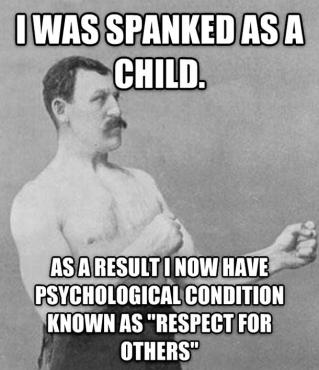
“I was spanked as a child and I turned out fine”


A Facebook Friend (who is also a blog reader, hi!!) recently posted this meme on her timeline:

for-those-of-you-who-are-against-spanking-your-children-79911

As a result of spanking or in spite of it?

Hitting children is not new and the world has kept on turning, I’ll concede the point. But I always get a chuckle when people claim that despite something “they turned out all right” . From politicians to policy-makers, business and community leaders, from the smallest to the largest units, people “who turned out fine” are having the babies, making the decisions and overall having a direct impact on the world we live in.

The numbers are in and can we really pretend that “we turned out all right”? Whether you lean left or right, it’s hard to argue that everything is all right with the world today. As a society, we’ve been unwilling to care enough about the consequences of our purchase decisions to pay for their actual cost. From environmental degradation to sweat shops, if our wallets are happy, we’re content to let “others” live with the consequences of our actions. We have a hiccup of remorse when tragedies like the Rana Plaza put us in front of our lifestyle choices but not enough to change anything. That would require sacrifice. And sacrifice is hard, especially when it involves others. We like the kind of sacrifice that get us ahead somehow. Like saving money, or going to school. Paying $200 for a pair of ethically sourced shoes? What’s in it for me?

Any minute increase in the price of gas  or electricity sends us writing to our MPs. Heaven forbids we should pay the actual cost of our endless thirst for energy. We want the SUV and the soaring two-storey windows in a sub-polar climate, how are we supposed to have this without energy subsidies? We subsidize the rich and the poor equally in the name of an infantile understanding of fairness. We hate to pay taxes, yet expect Cadillac entitlements on a K-car budget. Let the others pay the taxes. We shake our heads in contempt at governments’ willful blindness on debt, deficits and quantitative easing, yet we run our personal spreadsheets according to similar principles. We vocally take financial institutions to task for raking-in record-breaking profits while doing the same thing with our personal money. Let them share the banks’ obscene profits but not those of our favorite sports and entertainment personalities. We elect tax-cutting governments, then turn around and require social services. We suffer from a collective inability to be consistent with our political and economical beliefs. It’s all about me: my money, my entitlements, my job, my lifestyle, my stuff. We lean left when the State giveth and right when the State taketh away. We are unable to see that our day-to-day decision-making reflects that of the world leaders and financial planners we so adamently denounce for their self-serving ways.

We were spanked as children and turned out all right, yet incidences of mental illness and addictive behaviours are soaring, not only amongst ourselves but in our children as well. School yard bullies and victims grow into workplace bullies and victims. We profess zero-tolerance as harassment and belittling reduce our neighbours and colleagues to rubble. We reach deep into our reserves of righteous indignation when a child dies at her own hands but we look the other way when the hazing happens in our own backyard. How many parents of bullies were spanked as children and turned out all right? How many bullies have grown out of attachment voids passed down generations? Meanwhile, social and medical academic litterature has been linking addictive behaviours to unmet attachment needs since the ’70s and we keep spewing nonsense about “turning out fine.”

We are not fine. Our marriages are not fine. We are unable to put others’ wellbeing before our own, even when research consistently shows that children are wounded even by the most amiable of family breakdowns. Whenever someone declares that they were spanked as children “and turned out fine” I always want to start a game of 20 questions: oh yeah? How’s your relationship with your teenagers? How many relationships have you left? How’s your relationship with your boss? Your colleagues? Authority? Your faith? Are you still with your spouse? Is it possible that the voids in your life might have been left by unmet attachment needs? Would you entertain the idea that being hit by your parents might have had an influence on your inability to persevere through challenges or — the opposite — to leave abusive relationships?

We suffer from that psychological condition known as “respect for others” which causes us to share heartwarming viral stories about disabled people beating all the odds while we terminate our disabled pregnancies in ever increasing numbers. With the growth of prenatal diagnosis and the expectation that “the government” will take care of our medical needs, the primary care of physically and mentally disabled people has become a matter of choice. We call ourselves tolerant, fighters, believers. But when our turn comes to rise above, accept difference and take a chance at love when love is scary, we refuse. Today, 9 out of 10 pregnancies of children affected by Down Syndrome are terminated. Our psychological condition known as “respect for others” doesn’t extend to our own children, which we are not quite ready to love unconditionally. We tolerate difference only in the most limited sense of the term: to allow the existence of something that we do not necessarily like or agree with. We celebrate difference on the outside but on the inside we believe that the disabled life is not worth living. 

In a recent ad for a radio segment on Alzheimer’s disease, the announcer declared: “Alzheimer’s: first it robs you of your memories, then of your physical abilities, and eventually of your dignity…” Does it really? Is the indignity of the aged and the ill such an accepted fact that we no longer pretend to respect them? Our psychological condition known as ‘respect for other’ is an exclusive club where the “other” worth respecting is young, healthy and suitably well-off. The poor and the downtrodden need not apply: we’re so full of “respect”, we no longer have room for compassion. 

So stop with the memes already and go hug your kids. Your parents’ smacks are not genetic, you don’t have to pass them down a generation. Let’s see if love can build a better world than spanks have.  


A keepin’ it real post: How my children sleep 


Sleep. What can I say about it? We all need it. Nobody gets enough of it. If you are like me, your sleep deprived brain is running laps trying to figure out what you can do to get a better night of sleep. After all, isn’t everybody else getting great sleep? We buy the books, and the contraptions, we hire the consultants. Amber teething necklaces, woombies, and these special hammocks that are supposed to replicate life in utero. We stop eating dairy and gluten, we start eating dairy and gluten, it must be pork, eggs, or onions. Is cabbage supposed to be good or bad? Should I start or stop drinking? Once you’ve been eating nothing but water and plain mashed potatoes for a month, you start wondering if it couldn’t be the water… And all the while, your friends and families keep telling you about all the babies who sleep so well and you wonder where you went so wrong.

I get messages seeking sleep advice on a weekly basis. From these exchanges with harried parents, I have concluded two things: (1) People lie. All the time. And (2) People forget. Which is good news, no?

People lie when they describe their own child’s sleep. Or at least, they omit crucial details. Like saying that your “Baby slept through the night at 3 weeks” when what you mean is that your baby only woke-up to nurse and not to chat for 2h. Or that by “night” you mean from midnight until 5 am (which is still awesome in my books but can lead a tired parent to believe that you mean a real night, like 8pm until 6am). Or the most egregious lie of all, that your baby “just slept” when what you mean is that you sleep trained him with the 4 months sleep regression. Some babies do sleep solid nights from birth. Those are unicorn babies. Awesome but not normal.

People also forget. Those are usually the people in the “grand” category, whose own sleepless nights are 20 or 30 years removed. They just remember the sweet smell and the soft spots and firmly believe that their own children said please and thank you from birth, ate all their spinach, and of course, slept like angels.

And here you are tired parent, wondering how you are failing your baby, your marriage and yourself. Convinced that you are rowing alone, lost in the duldrums of sleep.

You’re in luck! Here I am. Tired mother of 9. I have the grown kids and the little kids and I haven’t slept well since 2009. I had the naturally good sleepers and the horrible sleepers and I’m here to tell you: how your baby sleeps (or not) has far less to do with your parenting skills than you think.

It always puzzles me how we like to Hum and Awe at birth weights, how they are all different, and don’t you dare send a birth announcement without that key piece of statistics and yet, when it comes to sleeping and eating, we expect our vastly different children to comply to some made-up matrix of when and how. Children are not machines (neither are you). They have different bodies, different personalities, different life experiences  — yes, pregnancy matters, as does their early days and weeks — that are reflected in their sleep patterns and attachment needs.

Babies’ sleep patterns often seem directly opposed to our welfare as parents. This doesn’t make much sense from an evolutionary perspective, does it? Since babies’ survival depends on their parents, one would think that their primary needs would be better aligned with ours. But are they? After all, we as adult often share our beds with another adult. And we wake-up at night to pee or even to snack sometimes. We often watch tv later than we should because we simply can’t go from up to down on a dime. Yet we expect our babies to sleep on cue, alone, and without waking-up. It often occurs to me that we demand better sleep from our babies than we can achieve ourselves. We’re funny that way.

Are our babies misadapted or are we? If you are not entitled to a maternity leave, you might be back at work within 3-6 weeks of giving birth, at a time when your baby needs several — sometimes cluster — small meals of breastmilk every 2-4 hours. Are babies broken or is expecting mothers back at work within 6 weeks delusional? If you have a maternity leave, you are probably hoping to work-out that baby fat, socialize and complete these projects you’ve been putting-off since you got pregnant. Or take a university class and start a business. Instead of seeing mat leave as allowing us to care for our infants, we see it as personal development months, free from the shackles of work. Well, about those shackles…

If you are a stay-at-home mom, you probably expect to be back in the swing of things, organizing and attending activities. The isolation of the modern homemaker is forcing us to be everything to everyone in our family, without the help of a village of older mothers, aunts and grandparents whose sleepless nights are far and gone. Our children can no longer busy themselves with little neighbours, they need us to entertain, stimulate and socialize them while the neighbours are in daycare and preschool from dawn until dusk.

Here’s the rub: we could align our primary needs with those of our infants but our modern lifestyle and expectations prevent us from doing so. The fitness classes, playgroups and doctors appointments run us ragged when we should be napping with our babies. Our expectations that babies should not “take over our lives” lead us to stubbornly insist that baby sleep in his own bed, in his own room rather than keeping him close. We live in fear of preventing maturation and individualizations, of waking-up one day with a nursing, co-sleeping, college student. We fight our babies every inch of the way and wonder why we are so tired. That’s why. Your life is the problem, not your baby. Try to manage your expectations rather than your infant and see if it helps (it should).

Today, I want to share with you how our babies sleep. So next time your spouse or your mom exclaims: “This is not normal!!”  you can say “actually, it is”.

IMG_8957

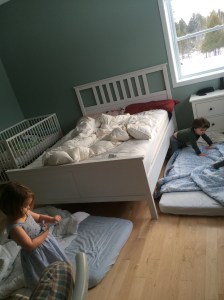
This is a picture of our master bedroom (in March 2015). The baby sleeps in a crib beside our bed. We have two crib mattresses for middle-of-the-night visitors. We push the crib mattresses under our bed during the day.

Our baby is almost 11 months-old and still wakes-up twice a night to nurse (sometimes more, never less). He slept through the night from birth until 4 months. At 4 months, he started waking-up once. Around 6-7 months, he started waking-up twice. Around 9 months (and cutting 6 teeth) he started waking-up all night. Now we’re back to nursing twice overnight. He goes to bed around 7pm, wakes-up to nurse around 11pm and again at some point in the night. I don’t know when because I don’t have a clock in my room. I ditched the clock when the twins were babies. Seeing how often I woke-up made me angry and resentful. Instead of managing my babies, I managed the clock. Believe me, it made it easier. When Damien wakes-up, I grab him from the crib and nurse him side lying in my bed. Then I plunk him back in his crib.

At some point during the night, the twins (3.5 years-old) come into our bedroom. Ève is usually grouchy. She needs to cuddle-up with us in bed. She will usually go back to sleep between my husband and I and I will put her on the cot on the floor when the baby wakes-up to nurse (a queen bed is crowded with 4). Lucas just stumbles into our room and crashes on a cot on the floor and goes back to sleep. 3-and-a-half is a tough sleep age here: Sarah just left our room at age 5 and now the twins are here. By the time they are done, Damien will probably be replacing them. Round and round we go.

I remember when my older kids were little, everybody was concerned about “returning the kids to their rooms” and “getting them used to sleep in their beds all night.” People discussed whether they should lock their bedroom door and let the children cry at the door. Anything but having a child in your room.

We tried all these things. Now, when someone suggests that I cut this crap out, I know that this person has sleep to spare. I don’t. Here’s a secret: If some parents tell you that they close their bedroom door or walk their child back to bed throughout the night, it means that they are not as tired as they say they are. You need to sacrifice sleep to listen to your child howl at your bedroom door or walk him back to his bed 200 times. I know, I used to do it. Now I need sleep. And sleep means letting my children do whatever they need to do to to go back to sleep.

That’s what our nights look like. Because I don’t have a clock, I don’t know how long a stretch of sleep I can get. My guess is 2-3h at the most. And you know what? I’m not as awesome as I would be on a full night. I move slowly. My writing is not brilliant. My house is never completly under control. I’ve been trying to host a house warming party since December and I just can’t, I’m too tired. We do barebones homeschooling. My husband does groceries on his way back from work because I don’t have the wherewithal to take 4 young kids shopping and remember what I’m supposed to buy. I have a lot of professional and personal ambitions sitting on the back-burner until I can focus on things beyond immediate care and feeding of myself and my family. I don’t sit on boards, I don’t volunteer. To everything there is a season.

This is the season for digging your head in and plowing through.

Ontario’s new Health and Phys Ed curriculum: this is not a cafeteria


The roll out of Ontario’s new Health & Physical Education curriculum (better known as “sex ed”) has caused a flurry of activity on my Facebook feed. I feel blessed to have friends and acquaintances on every side of this issue but it makes Facebook commenting a bit of a mine field. Try as I may to post nuanced positions, the reality is that social media is a not a friend of nuance. That’s why I have my blog: so I can annoy everybody — from left to right — at the same time… But only if they choose to read me.

This? That's me in my natural state.

First, let’s get the elephant out of the way. I am a practicing Roman Catholic. As a matter of religious doctrine, I believe myself — and that handsome guy I make kids with — to be my children’s primary educators. This means that the responsibility to choose what my children learn falls squarely and unequivocally on my shoulders. The decision to send my children to school or to keep them at home is a religious right, or should be. Many Catholic parents oppose the new sex ed curriculum because they see it as an usurpation of parental authority and their role as primary educators. Not, take note, because they are afraid of the real names of their genitals or what they are used for. In fact, many of us wish teens would learn more about how their reproductive systems work. More on that later. 

I am a Catholic parent but I am also a citizen. I live in a democracy which is — as Sir Winston Churchill reminds us — the worst form of government except for all the others we have tried so far. When Premier Dalton McGuinty announced the new and improved curriculum a few years ago, the outcry on the eve of provincial elections caused the hasty retreat of the controversial new elements. The new Premier Kathleen Wynne promised to reintroduce the curriculum and is showing no sign of backing down. The people who have elected her are reacting with a collective shrug or, as a Facebook friend of a friend wrote: “I’m so glad they’ll be teaching consent.” Because really, how else are young men and women supposed to learn what a consensual sexual relationship is unless they learn it in school? My point is that the people who elected the Ontario Liberal Party are generally happy with the curriculum changes, either because it reflects their own values on health and sexuality or because they don’t care. The parents currently storming the barricades are not those who elected Premier Wynne. Is it a surprise to learn that she is not sensitive to their plight?

As my friend John Robson explains very well in this short video, the provincial government is in the business of teaching civics and morals. You may argue that the government should limit itself to value-neutral academics such a reading, writing and arithmetic but this would be a theoretical exercise at best: the Education Act spells the role of the school system in shaping values and morals very clearly. You’re in for a penny you’re in for a pound: once your children are under the auspices of our state-run education system, the system makes the rules. And that includes the rules about dating, mating and reproducing (or, preferably, not reproducing). As Justice Deschamp wrote for the majority in the 2012 case pitting Quebec parents against the Quebec government over the contested Ethics, Culture and Religion (ECR) curriculum (emphasis is mine):

Parents are free to pass their personal beliefs on to their children if they so wish. However, the early exposure of children to realities that differ from those in their immediate family environment is a fact of life in society. The suggestion that exposing children to a variety of religious facts in itself infringes their religious freedom or that of their parents amounts to a rejection of the multicultural reality of Canadian society and ignores the Quebec government’s obligations with regard to public education.

Yup. That’s right. While this decision refers to a different curriculum in a different province, it does a good job of highlighting the highest court’s sentiment with regard to parental rights in education. I have heard many people, several teachers themselves, argue that the school had to teach sex ed because the parents weren’t. That’s not true. The Ontario education system has to teach sex ed because matters of civics and morals are part and parcel of its mandate. You might argue that this does not correspond to your idea of civics and morals but you ascribed to that vision when you registered your children in school. Remember that dotted line? Your name’s on it.

In an address at the Maryvale Academy Gala last January, Ottawa Archbishop Terrence Prendergast  tore into Kathleen Wynne’s new Health & Physical Education curriculum calling it a “seizure of parental authority”. He said (emphasis mine):

“We know that the proposed program threatens the fundamental right of parents to educate their children in the moral dimension of sexual behaviour (…). Parents are best qualified and have the greatest interest in working with their own children to handle this serious topic at an age and developmentally sensitive time,” he continued. “More notably, parents have the fundamental right to do so―a right the Province appears willing to usurp without due consideration.”

(You can read the entire address here.)

Willing to usurp? The Province is not merely “willing to usurp” the role of parents as primary educators, it’s obligated by law to do so. As for the fundamental right to educate children in matters of morals, this is a right that is not recognized by law. As the Supreme Court clearly stated, that right stops at your front door. Some of my Facebook friends who support the curriculum updates shrugged: “It’s a great curriculum. Those who don’t agree just have to opt out.” Believe me, as a parent who had to pull an anxious child out of Health & PE:

ikeiw

I had to collude with my daughter to find out exactly when to pick her up. Had my daughter not been a willing participant, I would have had no way of knowing when the Health component of the PE class was being taught. Then she would be marked as “absent” — which adds up on her report card — and still expected to write the Health & PE test, failure to do so would also show on her report card. I was glad to give my daughter an occasional break from “Health” but on the whole, she still had to learn the stuff and write the test. Opting out? Not exactly. And here’s the difficult lesson of my post so far: you can’t really opt out of Health & PE even though you have a theoretical right to, as per the Education Act. You have to opt out of the system. We took our children out of Health. And French, math, science and history too. We homeschool. You’re not happy with the extent of government encroachment on your role as primary educator? Your options are: (1) change the Education Act; (2) force the rolling back of the curriculum by electing a government that supports your vision; (3) take your children out of public school. I’m sad to inform you that the happy middle where you get to send your kids to school to learn things you want them to learn at the exclusion of those you don’t like is not an option. Sorry. This is not a cafeteria.

Education is always political. Remember what they say about the hand that rocks the cradle? Well, if you don’t, the Provincial government does, as does Canada’s highest court. There is no such thing as a value-neutral sexual education class. The term “safe sex” is not value neutral. Neither is “risky behaviour”. When I helped my grade 8 daughter study for her Health exam, I learned that Natural Family Planning was also known as “the calendar method” and had a success rate of 30%. This kind of misinformation is not value-neutral.

What your children learn in school is always political. It may look neutral if you share the values promoted in the curriculum but your comfort is only as safe as our democratic system: someday, the tables may turn. After all, the social conservatives — be they Christian, Muslim or Jewish — are having all the babies. Do you think Michelle and Jim Bob Duggar are raising feminists and allies? Doesn’t this make you a little squirmy about the world your 1.3 children will grow into?

Believe it or not, I am not losing sleep over the so-called graphic content of the new curriculum. My extended family has a few same-sex married couples and a transgendered woman. I have dear friends of all colours of the rainbow. Gender fluidity is a fact of life in my family. The mention of masturbation in grade 6 and sexually transmitted diseases and co-related risky behaviours in grade 7 are not phasing me in the least: by then, my children had long been exposed to them in the school yard and especially the school bus. Our bus drivers always listened to mainstream pop radio, where hip hop songs are way more explicit than anything their gym teachers could dream-up. Honestly, your children’s innocence is only as safe as that of their peers.

If anything, I wish the curriculum taught more about how babies are made! I had a conversation with my daughter a few years back while she was texting a friend. Both girls had received the best sex ed the school system could provide. A friend had had unprotected sex during her periods and wanted to know if she could get pregnant. Both thought that ovulation happened during menstruation. So here we are, giving our teens all the information they need to have safe sex. All the information except how babies are made. 16 year-old girls are having unprotected sex without the foggiest clue of when they are fertile. Great. Have we thought of letting kids figure out how to masturbate on their own and teach them how babies are actually made instead? Just a thought.

Nobody should be complaisant about the government’s mandate to teach sexual education. You may be fine with the current state of sexual education but if you — like me — live in a democracy and enjoy the perks of political freedom, you may very well find yourself on my side of the barricades one day. And I promise that I will still be there with you.

L’école à la maison en français en Ontario: à quoi ça ressemble?


J’ai très peu publié depuis notre déménagement. Les ados utilisent mon ordinateur pour leur travail d’école et mon cerveau fonctionne au ralenti en soirée.

Il y a longtemps que je vous ai promis une publication sur l’enseignement à domicile en français. Je dois avouer que cette publication s’est fait attendre parceque nous nous ajustons encore au rythme de l’éducation à domicile. Les bonnes intentions de septembre se sont métamorphosées en réalité de janvier. Mise en face des limitations bien réelles de la vie dans une famille nombreuse avec deux enfants de 3 ans et un bébé, j’ai du rabattre les voiles de mes ambitions académiques pour faire face à la tornade de ma vie quotidienne.

Commençons donc au commencement. Quel était le plan original? Lorsque j’ai décidé de faire l’école à la maison, mes enfants souffraient d’un genre “d’écoeurantite” aiguë du français. À chaque Noël et pour leurs anniversaires, ma famille et moi nous efforcions de leurs trouver des romans à la mesure de leurs intérêts et de leur intelligence mais en vain. Seulement notre ado du milieu les lisait. Les autres s’en tenaient à leur position de départ, en quelques mots: “les livres en français, ça suce.” N’a aidé en rien le face-à-face violent entre mon fils aîné et la politique du français en vigueur à son école secondaire: les élèves n’avaient le droit de lire en anglais qu’en classe d’anglais. Pris en flagrant délit de lecture en anglais à plus d’une reprise il a été averti, averti encore, envoyé chez la directrice, ses parents ont été consultés et finalement mis en retenue. Sérieusement. Le français, c’était la langue de l’école, la langue du travail et la langue des enseignants un peu craqués qui mettent un garçon de 16 ans en retenue parcequ’il lit “Shake Hands with the Devil” dans sa langue d’origine. Enfin, ça ne donnait pas des rapports cordiaux entre mes enfants et leur langue maternelle. J’avais l’intention de réparer tout ça. Puisque mes enfants sont des lecteurs avides, je pensais enseigner le français d’une manière organique et plaisante à partir d’ouvrages de qualité intemporelle, ce que la pédagogue Charlotte Mason appelle les “living books”. Et c’est avec ma grammaire d’une main et mes livres vivants de l’autre que je m’apprêtais à redonner à mes enfants le goût du français.

Je n’ai pas réalisé que cette approche demanderait beaucoup de préparation pour maman et un minimum de bonne volonté de la part des enfants. Nous n’avions ni le temps pour l’un, ni le germe de l’autre et mes meilleures intentions se sont retrouvées le nez à l’eau. J’ai donc réajusté le tir et commandé des bons vieux exercices de français.

Voici maintenant la partie difficile, celle où j’admets mes erreurs et vous recommande de ne pas faire les mêmes. Puisque la grande majorité de mes lecturs francophones se trouvent en France, je me permet de commencer par une mise en contexte. Les francophones en Ontario sont en situation minoritaire. Le français est une langue officielle au Canada (avec l’anglais) et nous avons accès à de nombreuses ressources en français, même à l’extérieur du Québec. Mes enfants sont allés à l’école en français pour toute leur scolarité et ma fille aînée étudie à l’université en français. Malgré toutes ces ressources, nous devons quand même tenir les rennes du français bien en main pour le transmettre à nos enfants. Hors de l’école, la vie se vit en anglais.

Avant le déménagement nous habitions dans une région traditionnellement francophone et j’ai un peu — regard piteux — pris le français de mes enfants pour acquis. S’ils me parlaient en anglais, je répondais en anglais. Je les laissais jouer ensemble en anglais. J’écoutais surtout la radio en anglais dans l’auto et à la maison. Bref, lorsque nous avons retiré les enfants de l’école, leur exposition au français a chuté dramatiquement. Et soudainement, je me suis retrouvée à ramer à contre-courant. Je me suis soudainement imaginée avec des petits-enfants qui ne parlaient pas un mot de français et pour qui j’étais la mamie un peu bizarre qui leur parlait une langue qu’ils ne comprenaient pas. C’est aussi facile que ça l’assimilation. C’est un phénomène qui se produit par négligence plutôt que par application.

J’ai donc du retourner au B-A-BA de la vie en situation linguistique minoritaire et reprendre le contrôle du français à la maison. En commençant par l’école à la maison. J’enseigne toujours le français et l’anglais langue maternelle, c’est-à-dire que les deux langues sont apprises en tant que langue première. Mais le français, qui était souvent négligé par manque de temps de préparation a repris une place de premier ordre lorsque j’ai abdiqué et commandé du matériel éducatif “tout fait”.

Pour les petits (qui sont en 1ière et 3ième année, ou pour mes lecteurs français, CP et CE2) j’utilise les magnifiques ressources de la librairies des écoles. La librairie des écoles publie la méthode de mathématiques de Singapour, qui est non seulement réputée pour ses excellents résultats mais rencontre les attentes du ministère de l’éducation de l’Ontario. Et même un peu plus: mon fils de 9 ans a du commencer avec le manuel de CE1. Nous utilisons ces ressources pour le français (lecture, écriture, grammaire) et les mathématiques. Ils ont aussi un manuel d’éducation civile et morale qui me tente bien. Malheureusement, la librairie des écoles ne publie que pour le cycle primaire. J’aurais bien aimé en avoir pour les grandes aussi. J’ai également fait imprimer en couleur le manuel ancien Mico le petit ours que nous utilisons ensemble pour faire changement. La méthode syllabique très simple convient parfaitement à ma fille qui a un peu de mal en lecture.  Nous apprenons aussi des poésies que nous trouvons dans le Larousse de la poésie pour enfants.

Je supplémente les mathématiques avec Khan Academy (en français!) pour la pratique. Les enfants aiment bien pouvoir travailler sur l’ordinateur, ça change le mal de place.

Pour les sciences, j’ai commencé en septembre par une approche classique (genre “cours classique”) avec beaucoup de lecture et d’apprentissage par cœur (classifications, branches, genus…) mais cette approche ne sayait pas du tout à mes enfants actifs. J’ai donc demandé à David de choisir trois espèces animales qui vivent près de chez nous: un oiseau, un mammifère et un insecte. Il a choisi l’ours noir, le faucon et la coccinelle. Nous allons faire une étude approfondie de chaque espèce avec beaucoup de bricolage et d’exploration de notre forêt pour apprendre l’habitat. J’ai trouvé un curriculum complet sur l’ours noir avec feuilles d’activité sur le site de Ministère des ressources naturelles de l’Ontario sur lequel je me base.

Nous apprenons aussi le corps humain avec un livre des éditions Usborne (en français!). Nous avons beaucoup de plaisir à impressionner papa par nos connaissances des os et des systèmes du corps humain.

Pour les grandes (en 8e et 9ème — 5ème et 4ème pour mes amis français, secondaire 2 et 3 pour les québécois) j’utilise un mélange de livres (elles doivent lire en français à tous les jours), de dictée (et oui, la bonne vieille dictée ) et de grammaire Bled. Elles peuvent choisir leurs lectures. Elle doivent également lire et transcrire des œuvres de poésie. Je les prépare lentement à faire de l’analyse de poésie. Côté composition, elles ont des lacunes assez majeures et je crois qu’elles ont besoin de lire sans obligation (à part de le faire!) avant que je puisse les pousser plus loin. Nous sommes en mode “récupération”. Les mathématiques et les sciences se font en anglais. Si elles devaient réintégrer le système scolaire (ce que ma plus vieille espère) elles devront aller à l’école anglaise. Je préfère donc qu’elles y soient préparées. À partir de la 9ieme, elles prennent leurs cours de math et de science en ligne via “Virtual Learning Centre”. Elles reçoivent leurs crédits secondaire de l’Ontario et recevront donc un bulletin qu’elles pourront utiliser lorsque viendra l’heure d’appliquer pour leurs études post-secondaires. Côté pratique, c’est une chose de moins dont j’ai besoin de m’inquiéter.

Et voilà, un sommaire bien rapide de nos études en français à la maison. Je trouve la plupart de mes ressources éducatives sur Amazon.fr et plus rarement, Amazon.ca et la Librairie du centre à Ottawa. Je suis aussi accro du très beau site français Les petits homeschoolers où je trouve toute sorte d’idées intéressantes et d’activités à faire avec les enfants.