Confronting Envy


It started innocently enough with an online sale. The kind of online sale that let’s you meet likeminded parents: cloth diapers, children’s bikes. This one was for a ring sling. While teaching the buyer to use my ring sling, we had stricken a conversation about twins. This young mama had 6 month-old twins, her first children. I looked at her with the confidence of the mother who has it all figured out and said: “I know how tough it is right now but don’t worry: they’ll sleep someday, it gets better.” She said: “Oh sleep is no problem! Since they were born we made sure to have a really consistent bedtime routine and when we tuck them in their beds they know it’s sleep time and they just go to sleep!”

Well, I try hard not to swear but F-my-luck. I haven’t slept a good night since 2009 and having twins nearly killed me. From the day they were born until Lucas was 16 months I did not sleep longer than 45 minutes in a row. When he was 10 months-old I realized that I had seen every single hour on my alarm clock, every single night, for the last 10 months so I got rid of the alarm clock. It was easier than getting rid of the baby. That young mom’s innocent comment made me feel like maybe I had missed something. Maybe I could have been sleeping all this time and my restless nights were due to a lack of skills or determination. And those negative feelings reopened a door I had long thought closed: the door of envy.

St. Thomas Aquinas defined envy as sorrow at the good fortune of others. Its flip side is rejoicing at the downfall of others. Envy is that silent “YES!!” moment when we learn of the downfall of someone we had been envying. As if something in us died when our neighbor succeeded.

IMG_3623

I struggled for many years with envy after my older children were born. I was convinced that my decision to put my career on hold while my children were young (ha! Famous last words as I still have young children almost 20 years later) was the right decision for our family. Yet, I looked with envy at the material things my friends who worked outside the home could afford. Vacations, cute clothes, and my holy grail, matching furniture. I mentally wished that their children would grow-up troubled as if I needed to see the proof that having a parent at home was better for children. As if nothing I was doing would have been worth it unless my children were happy and their children were screwed-up.

Now that I am a bit older and a bit wiser — and that I have a house full of matching IKEA furniture — envy doesn’t rear its ugly head the same way it did when I was younger. I no longer envy material things as much as accomplishments. I envy confidence, safety, and a sense of control. Which is ironic isn’t it, since I decided to have a large family? But this is how fear works in the darkest confines of our souls, keeping us from becoming a better, bigger, version of ourselves.

I caught myself wishing that this young mom’s twins would suddenly stop sleeping so well. To show her that she wasn’t really in control. I wished that she would discover that her parenting skills at imposing a bedtime routine that sent her kids straight into Morpheus’ arms had everything to do with her children’s natural disposition to sleep on cue. I assumed that they must have been bottle-fed in hospital and molded to an institutional schedule. What are we breastfeeding mothers to do when our healthy children protest our best attempts to conform them to our schedule? We are not going home at the end of our shift!

IMG_1134

A few months later, I learned that a friend with children had sold her house and purchased a similar-sized house in a less desirable suburban neighbourhood. The difference in prices allowed her and her husband to pay-off their mortgage and live comfortably debt-free.  I could just taste the freedom. Completely debt-free, home owning, new vehicle driving, holidaying, while in their prime earning years, with school-aged children…. Life: does it get better than that?

Well, of course the husband, you know…. And the wife well… That’s not mentioning the way their kids…. And the issues at school… Here comes envy again with its messy greasy hands leaving fingerprints all over my best wishes. Envy is the opposite of rose-coloured glasses. It stains what should be beautiful and inspiring and filters it through a dirty lens. Turned on itself, it makes us look like a diminished version of ourselves. Envy is self-limitation. It’s locking ourselves in a cage, with the key, wishing every one would join us in when we could simply fly away.

I realized that my envy was not only holding me down, it was preventing me from growing from my experiences and choices, whether good or bad. It also made small-fry of the fruits of those experiences and forks in the road. My life as a mother of 9 is fodder for this blog and countless helpful interventions with friends and strangers alike. I made poor financial and academic decisions that set me back in my career ambitions and my financial independence but these decisions have lead me down a path where I met dear friends, learned valuable lessons and grew more than I ever did playing it safe. Envy renders us myopic, deliberately blurring out distance and perspective, only allowing us to see what is directly in front of us. IMG_4132

How many “mommy wars” and “mama drama” are rooted in envy? How many poor choices are motivated by envy? How farther along would we be if we simply chose to learn from those who have done things better, or even just differently, than we have?

C.S. Lewis described hell as a door locked on the inside. When we let envy     pollute our relationships with others, we are not only locking ourselves in but expecting everyone to join us.

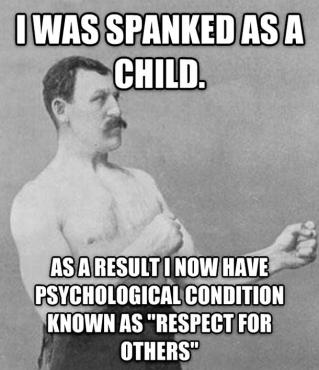
“I was spanked as a child and I turned out fine”


A Facebook Friend (who is also a blog reader, hi!!) recently posted this meme on her timeline:

for-those-of-you-who-are-against-spanking-your-children-79911

As a result of spanking or in spite of it?

Hitting children is not new and the world has kept on turning, I’ll concede the point. But I always get a chuckle when people claim that despite something “they turned out all right” . From politicians to policy-makers, business and community leaders, from the smallest to the largest units, people “who turned out fine” are having the babies, making the decisions and overall having a direct impact on the world we live in.

The numbers are in and can we really pretend that “we turned out all right”? Whether you lean left or right, it’s hard to argue that everything is all right with the world today. As a society, we’ve been unwilling to care enough about the consequences of our purchase decisions to pay for their actual cost. From environmental degradation to sweat shops, if our wallets are happy, we’re content to let “others” live with the consequences of our actions. We have a hiccup of remorse when tragedies like the Rana Plaza put us in front of our lifestyle choices but not enough to change anything. That would require sacrifice. And sacrifice is hard, especially when it involves others. We like the kind of sacrifice that get us ahead somehow. Like saving money, or going to school. Paying $200 for a pair of ethically sourced shoes? What’s in it for me?

Any minute increase in the price of gas  or electricity sends us writing to our MPs. Heaven forbids we should pay the actual cost of our endless thirst for energy. We want the SUV and the soaring two-storey windows in a sub-polar climate, how are we supposed to have this without energy subsidies? We subsidize the rich and the poor equally in the name of an infantile understanding of fairness. We hate to pay taxes, yet expect Cadillac entitlements on a K-car budget. Let the others pay the taxes. We shake our heads in contempt at governments’ willful blindness on debt, deficits and quantitative easing, yet we run our personal spreadsheets according to similar principles. We vocally take financial institutions to task for raking-in record-breaking profits while doing the same thing with our personal money. Let them share the banks’ obscene profits but not those of our favorite sports and entertainment personalities. We elect tax-cutting governments, then turn around and require social services. We suffer from a collective inability to be consistent with our political and economical beliefs. It’s all about me: my money, my entitlements, my job, my lifestyle, my stuff. We lean left when the State giveth and right when the State taketh away. We are unable to see that our day-to-day decision-making reflects that of the world leaders and financial planners we so adamently denounce for their self-serving ways.

We were spanked as children and turned out all right, yet incidences of mental illness and addictive behaviours are soaring, not only amongst ourselves but in our children as well. School yard bullies and victims grow into workplace bullies and victims. We profess zero-tolerance as harassment and belittling reduce our neighbours and colleagues to rubble. We reach deep into our reserves of righteous indignation when a child dies at her own hands but we look the other way when the hazing happens in our own backyard. How many parents of bullies were spanked as children and turned out all right? How many bullies have grown out of attachment voids passed down generations? Meanwhile, social and medical academic litterature has been linking addictive behaviours to unmet attachment needs since the ’70s and we keep spewing nonsense about “turning out fine.”

We are not fine. Our marriages are not fine. We are unable to put others’ wellbeing before our own, even when research consistently shows that children are wounded even by the most amiable of family breakdowns. Whenever someone declares that they were spanked as children “and turned out fine” I always want to start a game of 20 questions: oh yeah? How’s your relationship with your teenagers? How many relationships have you left? How’s your relationship with your boss? Your colleagues? Authority? Your faith? Are you still with your spouse? Is it possible that the voids in your life might have been left by unmet attachment needs? Would you entertain the idea that being hit by your parents might have had an influence on your inability to persevere through challenges or — the opposite — to leave abusive relationships?

We suffer from that psychological condition known as “respect for others” which causes us to share heartwarming viral stories about disabled people beating all the odds while we terminate our disabled pregnancies in ever increasing numbers. With the growth of prenatal diagnosis and the expectation that “the government” will take care of our medical needs, the primary care of physically and mentally disabled people has become a matter of choice. We call ourselves tolerant, fighters, believers. But when our turn comes to rise above, accept difference and take a chance at love when love is scary, we refuse. Today, 9 out of 10 pregnancies of children affected by Down Syndrome are terminated. Our psychological condition known as “respect for others” doesn’t extend to our own children, which we are not quite ready to love unconditionally. We tolerate difference only in the most limited sense of the term: to allow the existence of something that we do not necessarily like or agree with. We celebrate difference on the outside but on the inside we believe that the disabled life is not worth living. 

In a recent ad for a radio segment on Alzheimer’s disease, the announcer declared: “Alzheimer’s: first it robs you of your memories, then of your physical abilities, and eventually of your dignity…” Does it really? Is the indignity of the aged and the ill such an accepted fact that we no longer pretend to respect them? Our psychological condition known as ‘respect for other’ is an exclusive club where the “other” worth respecting is young, healthy and suitably well-off. The poor and the downtrodden need not apply: we’re so full of “respect”, we no longer have room for compassion. 

So stop with the memes already and go hug your kids. Your parents’ smacks are not genetic, you don’t have to pass them down a generation. Let’s see if love can build a better world than spanks have.  


So you want to pull your kids out of school


Our decision to homeschool coincided with the introduction of full-day kindergarten in Ontario’s public schools. I am not familiar with the details of the recent changes occurring in Ontario kindergarten classrooms but parents are telling me that the increase in school population brought-on by full day kindergarten has bumped-up class sizes across the board as other classes are combined to make room for the additional kindergarten classes. A field of portables – complete with graffiti – sprouted beside a shiny new neighbourhood’s public school (begging the question “how did you not see this coming and couldn’t you have built the school the right size in the first place?”) and a large extension to another new school was built in the schoolyard. In the land of “play-based learning” space to run around doing nothing is at a premium.

From full day kindergarten, to poor academic placement, to special needs, parents express a growing concern that while the school system is staffed by dedicated teachers and well-meaning principals, it is not serving the needs of their individual children very well. And so they ask about homeschooling. A lot.

A friend recently inquired about homeschooling and my reply inspired this blog post. Her question was not so much “why homeschool?” or even “how to homeschool?” but “what can I expect after pulling children out of school?” and “How will I stay sane?”

The sanity question is very much undetermined at this point. Homeschooling is hard and we are still negotiating the learning curve. My days are long and the nights are short. I remain sane by remembering why we are doing this. Thankfully, having five children older than the four youngest gives me perspective on how quickly this season will pass. I keep simple goals in mind on an hourly basis (don’t get angry, don’t yell, breathe) and the big picture in sight whenever I feel like quitting.

At this point in our homeschool journey – we started 2 months ago with 3 school-age children and will be adding a fourth in January – we are mostly learning to learn in different ways. The Internet calls it “deschooling” but I prefer using “deprogramming” to describe the process of bringing children home. We often assume (at least I did) that homeschooling is “doing school at home” – and for some that’s exactly what it is – but in reality, homeschooling is a paradigm shift. You will notice this paradigm shift in the comments you receive from people who do not support homeschooling: you can’t teach unless you are a teacher, you need to isolate children from their home environment for learning to occur, you need a lot of material support, you need a curriculum telling you exactly what needs to be learned when, you need a large group of same-age peers for socialization to happen. We are conditioned from a very young age to believe that schooling happens in a box. The physical act of removing the children from the box does not necessary change our thinking. There is a lot to learn in homeschooling and curriculum is only part of it. Here are a few unwritten lessons from my first two months of homeschooling after 14 years of school:

1. You will need to teach your children to trust you as a teacher. I had an interesting exchange with one of my daughters during the summer prior to the start of our homeschooling journey. We were talking about menstrual cycles – well, I was doing the talking — and I said: “When your periods start, they may not be regular for a while. You may skip weeks or even months.” And she looked at me with the kind of look you would give a lost puppy and said “I know mom, I’ve been to health class.” And this sums it up: your children, after years of conventional schooling, may love you and even respect you but their learning has been compartmentalized between the “home stuff” and the “school stuff”. You don’t understand their “new math” and “modern grammar”, you are no longer welcome to help in the classroom and your children don’t expect you to know jack squat. Don’t expect to jump into pre-algebra and traditional logic and think that your children will suddenly trust your superior brain. As far as they’re concerned, this homeschooling thing might just be another one of your “phases”, like that vegetarian kick of 2002. By the way, your mom and their teachers think the same way.

2. You will have to learn to learn at home. After years in school, your children are used to learning at school and flopping at home. The proximity to the kitchen, the toy room and the TV/computer can challenge academic work. I spent the entire month of September guarding the fridge. I’m not sure how they coped with fixed snack-times in school when I see how much fuel they need to keep their concentration.

3. You will learn to smooth the kinks in your relationship and discipline before learning can occur. Regardless of how good your relationship is, you can only teach so much if you don’t get along well with your children. And I mean this in the most loving way possible: we all love our children on the inside but the day-to-day grind often gets in the way of a cordial rapport on the outside. Parents of teenagers and toddlers, you know what I mean. To homeschool, you need to get along with your children on the inside AND the outside. It doesn’t mean that they become compliant little Stepford Kids but you need a basis of genuine compliance to move ahead with homeschooling. Learning to obtain compliance from your children without damaging your relationship – yelling, nagging or generally getting fed-up – may take weeks or even months but it needs to be done first. If you can’t get your children to clean-up their rooms without a fight, you have a taste of what homeschooling will look like day after day, hour after hour, until you quit in despair. Character before curriculum. I repeat this to myself about 2000 times a week.

4. Your children will have to learn to live with each other in close quarters. Your children may get along well at home or they may fight like cats and dogs, either way they will learn to work and live with each other. At school, they have been socialized to play strictly with children their own age. They have also been socialized into “girl play” and “boy play”. Boys and girls who play well together are often told they are in love with each other. Boys who enjoy “girl play” are often told they are gay. We all have stories of children who play well all summer with a younger neighbour only to royally ignore their best friend on school ground. We all have stories of older siblings who will not be seen with their younger siblings at school or on the school bus. Your children need to unlearn all this wonderful socialization to get along well in the context of the homeschool, especially if they are boys and girls. It may sound far-fetched but for our first month of home schooling, my biggest obstacle to teaching was the constant fighting between my 5 year-old and my 8 year-old. And I have 3 year-old twins and an infant, it says a lot.

5. You will learn to walk in confidence to the beat of your own drum. You will face opposition, criticism and soul-crushing doubt. The biggest failure predictor for homeschooling families (other than obvious challenges such as income loss, death and mental illness) is lack of confidence. If you doubt your ability to homeschool, there are good chances that you will prove yourself right. A few days ago, I heard a beloved family member explain to me how she didn’t think I could raise forward-thinking, engaging and open-minded teenagers in the context of the homeschool. A friend later suggested that she doubted my ability to teach advanced academics on the topics I did not master myself. Both are valid concerns coming from people I respect and care about, even though they show a lack of research on the ins and outs of homeschooling. I went to bed reeling, first thinking I would ruin my children forever, and then thinking I would prove everybody wrong. I got up this morning with a bone to pick and lined-up my little circus monkeys for a full day of academics. By lunchtime, I had to bitch-slap myself a few times to regain focus: I am not training circus monkeys, I am raising people. I will prove everybody wrong, all in good time. The proof will be in the fruit but I have to let the fruit ripen. Whenever I feel like I need to prove something to someone, I repeat to myself “Let the fruit ripen.”

Homeschooling is a journey of discovery, about yourself, about your children, and about the world around you. Whenever I feel wobbly and unsure, I remind myself that I am only taking my first steps. We will learn, we will grow and we will become stronger.

Whine and cheese


This post started as a description of a bad day. We all have them, don’t we? No matter how heavy or light our burden, some days (weeks, months) just won’t end. Or so it seems. The whine was spurred by a somewhat critical “You make everything look easy” from a friend. This shook me a little because if anything looks easy I can assure you that it’s all fluff and no substance. Anybody who sees me in real life – as opposed to social media – knows that whatever it is I’m doing, I’m (a) fumbling all the way; and (b) not doing it all that well. Every. Single. Day. I recently posted late birthday wishes to my father on Facebook, hoping that a public self-shaming would make-up for my poor daughterly behaviour, adding:

“Next time any of you wonders how Véro does it, remember that I don’t.”

That’s it in a nutshell. For every finite “thing” I do, there’s an equal amount of something else that doesn’t happen. My days, like yours, have 24h. If you look at what I don’t do, you will notice that the list of what I get done pales in comparison. That’s why I find it very irritating when people bow before me, which happens about 10 times a day when I am out and about with my family. Yes, you read that well, people bow before me. They actually, physically, bow before me. You can’t imagine how uncomfortable being worshiped can make you feel when you are not — you know — God.

Not only am I not God, I’m a wretched sinner. I order my life in concentric circles, building priorities from the centre and adding larger circles as I master the smaller ones. The smaller circles are my husband and children, my home life, around that core is my family, parents, siblings, in-laws; around the family circle are friends and close ones, this circle extends into my community. The largest circle would be those in need of my time and talent but who are not directly linked to me by the bonds of family, friendship or community. My faith radiates through from the core, informing how I (try to) relate to myself and others.

On a good day, I might make it to circle number 2. Everything else – friends, community, service – falls by the wayside. My every hour is consumed by caring for my basic needs and raising my children in a cheerful, peaceful and stable home where they can grow happy and healthy. Putting good food on the table, having clean clothes, a happy face and a listening ear takes-up my entire day. I am horrible at keeping in touch with my parents and siblings. I never remember anyone’s birthday, and when I do I don’t do anything about it. I’m a write-off when it comes to social graces like thank you notes. I have very few real friends left, and those who stick by me have precious little needs. I am not involved in my community; our family gives money to a few good causes because we can’t find the time to help out in a more meaningful way. If you are impressed because I manage to keep 9 children fed, dressed and somewhat educated assuming that I am also doing what normally productive members of the society do on the side, be informed that there is no side here: it’s all inner circle with a smattering of social media. In a nutshell it takes me 24h a day to be a decent wife and mother. That’s nothing to bow to.

Unlike some of my friends with larger-than-average families, I don’t have children with special needs. I don’t even have children with learning difficulties. In fact, all my children are above average students. They are physically, mentally and emotionally sound. My parents, my in-laws and my siblings are all in good health and economically wealthy enough to cover their needs as they age. There is no strife on either side of our extended family. There are no obvious mental health or substance abuse problems in our immediate family. We have been undeservedly spared by grief and loss. I should be able to do more with my 24h but for the limitations of my own person, my intelligence, my heart and my body. I am raising children whom I hope will be positive contributors to society, competent men and women committed to live by principles of integrity. I hope to look happy and peaceful doing it because the least I can do for the world from the confines of my kitchen – where I spend most of my life cooking, cleaning and homeschooling – is to give my children an example of self-giving that makes them want to choose others before themselves as they grow-up. Some days I fail miserably and that’s why I am still stuck in the innermost circles, trying to be a good mother, daughter, wife and sister before I move outward and onward.

Next time you are tempted to feel inadequate or bow before me or anyone else, remember that people like me need people with less stringent family obligations to make the world go round. Because I sure ain’t doin’ it. I need people like you to volunteer on school trips with my children, participate in bake sales, sit on board of directors, work as doctors, nurses and midwives, teachers, managers and creators. If you are dealing with loss, grief, illness, special needs or below average intelligence, you are already doing more than I am with my 9 healthy and bright children. So don’t bow. Don’t feel inadequate. Just go out and do your thing. From talking with you, I know that the more you already do, the more likely you are to feel like you’re not doing enough. Fill your 24h with purpose and hold you head up high.

Now go.

Parenting Quotes I’m Eating Back Today


I once read a quote. It went a little like this: “at the beginning of my career I had no kids and 12 principles; today I have 12 kids and no principle.” I was blessed with 4 relatively compliant children before I gave birth to 4 more. When I was having children in my 20s, I believed – clears throat with embarrassment — that my success in raising easygoing children was no-doubt related to my stellar parenting skills. What I lacked in skills, I made-up in youthful exuberance. Now that I have experience and some skills, I will readily admit that I have no clue. It’s true. My experience parenting is like the used children’s shoes in my basement: no matter how many I keep, I can never find a pair of the right size, at the right time, for the right season. Over the years, I have developed an expertise in each one of my children but here’s the catch: no matter how many children I had, they all came out as unique individuals. Never seen before and never to be repeated again. Isn’t human reproduction amazing that way? If 18 years of parenting has taught me anything, this is it: the lessons learned from raising this child are rarely applicable to raising that child. I still don’t know what I’m doing but I am more “zen” about it. Instead of seeing children as problems to solve, I see them as a puzzles to complete. I did not draw the picture, but with careful dedication I can help it come together.

When I think about my early years as a parent, it is often to eat back some pearl of wisdom with a generous serving of Humble Sauce. Gulp. Here are some of my gems.

“Children won’t draw on walls if they have access to paper.” Did you know that I spent the first 8 years of my life-with-children without a single drawing-on-walls incident? Then we sold a house and shortly before we moved my 3 year-old decorated a wall with black permanent marker. Now I have children who won’t draw on paper if they have access to a wall.

“I will never buy size 6 diapers.” Seems simple enough: if a child is big enough to wear size 6 diapers, he’s old enough to potty train. Right? Guess who just purchased a Costco-sized box of size 6 diapers for her nearly-3-year-old child? Take heart, all you parents of late potty-trainers for it turns out that potty-readiness is completely out of your hands. The good news is that accepting this simple fact will make potty-training a lot easier for everyone involved.

“I won’t let myself get fat.” When I was dating my now-husband, he came to visit me at my parents’ house on his motorcycle wearing his full-leather gear. I was in the pool at the time and we couldn’t resist the temptation to take a biker chick picture, him in his leather chaps, me in my bathing suit. I found out that I was pregnant shortly after and upon seeing the picture, my aunt – who had 4 children – said “Keep that picture because you’ll never look like this in a bathing suit ever again.” I declared that I would not let maternity ruin my body. Well guess what?? Maternity never asked my opinion. Maternity took my body and turned it upside down. It moved my organs around and re-shaped my pelvis to its liking. It not only packed-on pounds as it was growing 9 healthy humans, it refused to lose even one as it was busy feeding them. I ran and I dieted and I ran some more. I stretched and planked and even starved myself at some point. It never went down. I got sick, I de-calcified my teeth, but I never lost a single breastfeeding pound. Today, after my easiest pregnancy and a beautiful home birth, I am breastfeeding a 4 month-old and a 3 year-old and I weight as much as I did during my last week of twin pregnancy. I am 60 lbs heavier than I was on that infamous picture 18 years ago and my dress size has more than doubled, going from 6 to 14. I’m definitely bringing booty back. And boobs. And legs.

“If your child is old enough to ask for breast milk, he is too old to nurse.” Refer to previous paragraph about nursing a 3 year-old. She’s been old enough to ask for milk for almost 2 years. She can explain the difference between cow’s milk (milk in a cup) and breast milk (milk in the mouth). Heck, she can ask for milk in both official languages.

What about you? Did you know everything about parenting until you had kids? What pearls of wisdom are you eating back today? Share in the humble pie!

Why I don’t spank or “The day my daughter slew me.”


This post was first published on Vie de Cirque in 2014. I am reposting it in light of the recent policy statement by the American Academy of Pediatrics recommending that parents avoid corporal punishment to manage challenging behaviour.

Yesterday, I was advised to spank my children for getting out of bed after bedtime. I was venting about our bedtime routine, gone wild with the longer summer days and the end of napping for the twins. Our twins are 2-and-a-half and our daughter is 5. All three have a hard time stopping long enough to let sleep overcome them. After sharing with friends everything we had tried, one of them suggested spanking them if they got out of bed. I was taken aback, a little speechless, and blurted out: “They would have no idea why I’m hitting them.” I would have liked to be able to say: “I never spank my children.”

I used to spank but I don’t anymore. When my four older children were young, I believed that spanking was part of any parent’s discipline toolbox. I believed, as I had been told by other parents, that nothing cleared the air like a good swat on the bum. That spanking was the only way to ensure compliance in certain situations. That some defiant behaviours such as willful disobedience and lying should be nipped in the bud quickly and unequivocally through spanking. The books I read were reasonable. Nobody suggested spanking infants or school-aged children. Every author or speaker insisted that parents should never spank in anger. That the bum-swat should be applied swiftly and unemotionally to children who are too young to understand the gravity of their actions. All the while, spanking made my children angry or miserable, not compliant. And rather than be unemotional about it, I was racked by guilt and the impression that there had to be a better way to raise respectful and considerate children. The reality was that I always spanked in anger: when I wasn’t angry, I could always find more constructive and respectful ways to get what I needed from my children.

When my 5th child was born, I decided to stop spanking. I decided that if hitting my child was the only way to gain the upper hand, I deserved to lose that hand. I would drop an argument before resorting to spanking. You see, the problem with spanking or yelling or any anger fuelled response is that it works. It works to blow-off steam; it works to obtain compliance from our children; it works to leave a lasting impression. The problem with spanking is not whether it works or not, but why it works so well. A toddler who resorts to hitting and biting understands how expedient physical punishment can be. And when I spanked my children, however rarely, I felt at the mental capacity of a toddler. There had to be a better way, for my children and for myself as I sought to become a better parent.

Why does spanking work? Is it merely the fear of pain that snaps our children back on the straight and narrow? Is the pain inflicted on your bum by a parent the same as the pain that is inflicted by a fall on the playground? Does spanking work on defiance just like a fat lip works on couch acrobatics? Or is there something about the pain inflicted by a parent that makes it more efficient? Any parent of a playground acrobat knows that pain is not always a deterrent. My two-year-old son was chasing a soccer ball in the driveway when the ball rolled under our van. Without thinking twice about his height in relation to the van’s clearance, he ducked under the van but hit the bumper then the pavement face first. He stood up, shook himself up, and carried on the pursuit with a bad case of road rash. Without a single tear. Yet, the same day, when he was particularly defiant at bedtime, I flicked his diaper area with one finger to hurry him along and the screams of pain were completely disproportionate to the “pain” I had inflicted. If pain was the only deterrent involved in spanking, toddlers who bite, hit and shove would be widely respected at home and on the playground. There is a singularity to parents hitting children that makes the pain more searing. We often justify spanking by saying that we do not really hurt our children. We know, even if we do not like to admit it, that spanking is not about the physical pain we inflict but about its emotional impact on our children. Spanking works. Not because it hurts but because the hurt comes from our hand.

When we hit our children, no matter how good the reason seems to be, we use the love and trust that bind us to our children against them. We play-up their natural fear of losing our love and affection and use it against them. Because let’s be honest here, what makes spanking so expedient is not the fear of physical pain but the fear of loss. And the loss feared is the most profound. Hitting our children, when it works in achieving compliance, is hitting at their core, not their bums. This breaks my heart when I think about it. In hindsight, I am glad that spanking never worked for us. I take comfort in the fact that it made my children angry rather than compliant. I am thankful that they were secure enough in my love to call my bluff.

Spanking works, but it works for the wrong reasons. It is also a behavior that is self-reinforcing because it yields immediate results while giving vent to our frustration. The positive feedback loop afforded by spanking when we are at our wits’ end quickly becomes hardwired. Even 10 years after I made the decision to stop spanking, I can still be heard threatening my children with a bum-whacking whenever I reach the end of my rope. I never follow through and they know that. But I hate that my mind still goes there more often than I like to admit. And my children, when looking after their younger siblings, can often be heard threatening them with a spanking if they don’t straighten up. The urge to hit in frustration is a powerful one. Once our brain has tasted the relief, it is hard to give it up.

I still hit the wall. Often. It happens when my children are simply so defiant and disobedient that hitting seems to be the only way to get respect. It happens at bedtime when the children take 2 hours to fall asleep and I need a break. It happens when they run away from me in a busy parking lot. It happens when I am desperately trying to leave and my efforts are met with stubborn resistance. It happens when my children are disrespectful and mean to me and each other. It happened recently when the twins and my 5-year-old were playing in the bathtub. That was the day my daughter slew me.

The children were in the bathtub, all 3 of them. I turned my back for 5 seconds to pick up my crying infant and in that split second, they dumped the entire content of a large jug of expensive body wash in the bathtub. I didn’t realize it immediately until they started crying because the soap was hurting them. Yes, soap, in large quantity, will burn your skin. I was so mad! This was not the first time. Earlier, we had vacuumed the entire content of a sunscreen bottle carefully massaged into our carpet. For my children, if it can be dumped or smeared, it has no reason to stay in a container. This is an ongoing issue with my 3 youngest, one of whom is old enough to know better. My daughter was crying that the soap was hurting her private parts. I was mad at her for letting the twins dump a $15 soap bottle in the bath without even calling me. In exasperation, I said: “I am so mad at you, I really feel like giving you a good spanking!” And she blurted out, in tears:

“No! Don’t hit my bum! My bum already hurts! I don’t need a spanking when my bum hurts like this, I NEED A HUG!!”

I felt like I had been struck by lightning. Even today, I can’t think about this episode without feeling a big lump in my throat. When our children push us to the limit, they are more likely in need of more care and affection than a sound ass-whippin’. My children resist bedtime when I am too busy to take them to the park after dinner. My 8-year-old middle child is rude when I’ve been putting off our game of Uno once too many. My 5-year-old is defiant when she needs more thoughtful attention, not more spanking. As for my toddlers, their thirst for discovery, their curiosity and their unbridled energy are qualities needing careful supervision until they can be channeled into useful accomplishments.

Parenting will bring you to your knees. If it doesn’t, you are doing it wrong. But ultimately, the flaws of stubborn determination, independence and curiosity will blossom into their most successful qualities. Don’t spank it out of them.


Why I don’t spank or “The day my daughter slayed me.”


Yesterday, I was advised to spank my children for getting out of bed after bedtime. I was venting about our bedtime routine, gone wild with the longer summer days and the end of napping for the twins. Our twins are 2-and-a-half and our daughter is 5. All three have a hard time stopping long enough to let sleep overcome them. After sharing with friends everything we had tried, one of them suggested spanking them if they got out of bed. I was taken aback, a little speechless, and blurted out: “They would have no idea why I’m hitting them.” I would have liked to be able to say: “I never spank my children.”

I used to spank but I don’t anymore. When my four older children were young, I believed that spanking was part of any parent’s discipline toolbox. I believed, as I had been told by other parents, that nothing cleared the air like a good swat on the bum. That spanking was the only way to ensure compliance in certain situations. That some defiant behaviours such as willful disobedience and lying should be nipped in the bud quickly and unequivocally through spanking. The books I read were reasonable. Nobody suggested spanking infants or school-aged children. Every author or speaker insisted that parents should never spank in anger. That the bum-swat should be applied swiftly and unemotionally to children who are too young to understand the gravity of their actions. All the while, spanking made my children angry or miserable, not compliant. And rather than be unemotional about it, I was racked by guilt and the impression that there had to be a better way to raise respectful and considerate children. The reality was that I always spanked in anger: when I wasn’t angry, I could always find more constructive and respectful ways to get what I needed from my children.

When my 5th child was born, I decided to stop spanking. I decided that if hitting my child was the only way to gain the upper hand, I deserved to lose that hand. I would drop an argument before resorting to spanking. You see, the problem with spanking or yelling or any anger-fuelled response is that it works. It works to blow-off steam; it works to obtain compliance from our children; it works to leave a lasting impression. The problem with spanking is not whether it works or not, but why it works so well. A toddler who resorts to hitting and biting understands how expedient physical punishment can be. And when I spanked my children, however rarely, I felt at the mental capacity of a toddler. There had to be a better way, for my children and for myself as I sought to become a better parent.

Why does spanking work? Is it merely the fear of pain that snaps our children back on the straight and narrow? Is the pain inflicted on your bum by a parent the same as the pain that is inflicted by a fall on the playground? Does spanking work on defiance just like a fat lip works on couch acrobatics? Or is there something about the pain inflicted by a parent that makes it more efficient? Any parent of a playground acrobat knows that pain is not always a deterrent. My two-year-old son was chasing a soccer ball in the driveway when the ball rolled under our van. Without thinking twice about his height in relation to the van’s clearance, he ducked under the van but hit the bumper then the pavement face first. He stood-up, shook himself up, and carried on the pursuit with a bad case of road rash. Without a single tear. Yet, the same day, when he was particularly defiant at bed time, I flicked his diaper area with one finger to hurry him along and the screams of pain were completely disproportionate to the “pain” I had inflicted. If pain was the only deterrent involved in spanking, toddlers who bite, hit and shove would be widely respected at home and on the playground. There is a singularity to parents hitting children that makes the pain more searing. We often justify spanking by saying that we do not really hurt our children. We know, even if we do not like to admit it, that spanking is not about the physical pain we inflict but about its emotional impact on our children. Spanking works. Not because it hurts but because the hurt comes from our hand.

When we hit our children, no matter how good the reason seems to be, we use the love and trust that bind us to our children against them. We play-up their natural fear of losing our love and affection and use it against them. Because let’s be honest here, what makes spanking so expedient is not the fear of physical pain but the fear of loss. And the loss feared is the most profound. Hitting our children, when it works in achieving compliance, is hitting at their core, not their bums. This breaks my heart when I think about it. In hindsight, I am glad that spanking never worked for us. I take comfort in the fact that it made my children angry rather than compliant. I am thankful that they were secure enough in my love to call my bluff.

Spanking works, but it works for the wrong reasons. It is also a behavior that is self-reinforcing because it yields immediate results while giving vent to our frustration. The positive feedback loop afforded by spanking when we are at our wits’ end quickly becomes hardwired. Even 10 years after I made the decision to stop spanking, I can still be heard threatening my children with a bum-whacking whenever I reach the end of my rope. I never follow through and they know that. But I hate that my mind still goes there more often than I like to admit. And my children, when looking after their younger siblings, can often be heard threatening them with a spanking if they don’t straighten-up. The urge to hit in frustration is a powerful one. Once our brain has tasted the relief, it is hard to give it up.

I still hit the wall. Often. It happens when my children are simply so defiant and disobedient that hitting seems to be the only way to get respect. It happens at bedtime when the children take 2 hours to fall asleep and I need a break. It happens when they run away from me in a busy parking lot. It happens when I am desperately trying to leave and my efforts are met with stubborn resistance. It happens when my children are disrespectful and mean to me and each other. It happened recently when the twins and my 5 year-old were playing in the bath tub. That was the day my daughter slayed me.

The children were in the bath tub, all 3 of them. I turned my back for 5 seconds to pick-up my crying infant and in that split second, they dumped the entire content of a large jug of expensive body wash in the bath tub. I didn’t realize it immediately until they started crying because the soap was hurting them. Yes, soap, in large quantity, will burn your skin. I was so mad! This was not the first time. Earlier, we had vacuumed the entire content of a sunscreen bottle carefully massaged into our carpet. For my children, if it can be dumped or smeared, it has no reason to stay in a container. This is an ongoing issue with my 3 youngest, one of whom is old enough to know better. My daughter was crying that the soap was hurting her private parts. I was mad at her for letting the twins dump a $15 soap bottle in the bath without even calling me. In exasperation I said: “I am so mad at you, I really feel like giving you a good spanking!” And she blurted out, in tears:

“No! Don’t hit my bum! My bum already hurts! I don’t need a spanking when my bum hurts like this, I NEED A HUG!!”

I felt like I had been struck by lightning. Even today, I can’t think about this episode without feeling a big lump in my throat. When our children push us to the limit, they are more likely in need of more care and affection than a sound ass-whippin’. My children resist bed time when I am too busy to take them to the park after dinner. My 8 year-old middle child is rude when I’ve been putting off our game of Uno once too many. My 5 year-old is defiant when she needs more thoughtful attention, not more spanking. As for my toddlers, their thirst for discovery, their curiosity and their unbridled energy are qualities than needs careful supervision until they can be channeled into useful accomplishments. I will no longer hit my children in response to my failures to parent in a thoughtful and intentional way.

Parenting will bring you to your knees. If it doesn’t, you are doing it wrong. But ultimately, the flaws of stubborn determination, independence and curiosity will blossom into their most successful qualities. Don’t spank it out of them.

DSC_0135

Are we killing you yet?


By popular demand, I translated my previous post on large families and the environment.

About a month ago, our family was the subject of a full-page feature in our local newspaper. This is not the first time that my little gang and I appear on the pages of a newspaper: last year, I took part in a Globe & Mail piece on the decision to stay home or return to work.

When you are the mother of a large family and you make a media appearance, you have to expect the global warming trolls to come to the party, regardless of the topic. We seem to be a looming menace: if everybody did what we did, the environmental impact would be disastrous. In theory maybe, but what about reality?

You don’t have to be a scholar in demographics to see that large families are not the cause of overpopulation. Assuming that you accept the arguments in favour of overpopulation. A quick glance at the literature shows that concerns over demographic decline are at least as pressing as those relating to overpopulation. Birth rates (the number of live births per thousand of population per year) and fertility rates (the average number of children born to women of childbearing years) are declining throughout the world. While many under-developed countries still show birth rates over the population renewal rate (2.1 children per women), their birth rates are in decline. Statistics suggest that the increasing world population is not caused by too many births but by an increase in life expectancy. In other words, we didn’t start breeding like rabbits; we just stopped dropping like flies. The elderly population is on the increase worldwide but the children population is decreasing steadily.

Blaming large families like ours for overpopulation discounts the fact that for countries like Canada, the fertility rate is significantly below the population renewal rate despite a handful of large families. Think about it: the fertility rate of 1.1 children per woman includes women like me. We don’t seem to be making a noticeable difference. If anything, we make demographic decline slightly less scary. I often meet funny people who enjoy telling me:

“I’m happy that there are people like you to make up for people like me.”

Except that we are outweighed: there are too many people like you for people like me to compensate.

Some will tell me that demographic decline is desirable to make-up for our poor ecological balance sheet. While it is true that resource abuse is threatening the environment, I would counter that what is killing the planet are abusive mentalities, not large families. If large families are too few to make a statistical difference in birth rates, what makes you think that there are enough of us to compromise the environment? Resource abuse and overuse happened in parallel with demographic decline. The problem is not simply how many people are killing the planet, but how they are doing it!

Our family lives in the suburbs of Ottawa in a typical wealthy suburban neighbourhood found throughout North America. Large single family homes, 4 bedrooms, double car garage. Two cars, or rather, one car and a larger vehicle such as a minivan or a SUV. The house we currently live in was designed for a family of 4 or 5 people. On my street, in houses of similar size and function, you will find mostly couples with no children or 1 or 2 children. Some are young families hoping to expand but most are older. They all live in 3 000+ sq. ft. homes built on former prime agricultural land, with 2 vehicles, air conditioning and heating brought to you by some coal-fired power plant somewhere in Ontario. It doesn’t cost more to heat-up 3 000 square feet for a family of 10 than it does for a family of 2 by the way. Except that with the size of my bills, when the weather is nice I open the windows. Most of my neighbours turn-on the A/C in May and turn it off in October. And while my pile of garbage is bigger than theirs, the truck moves for them as much as it does for me… and their garbage pile is not one fifth of mine, although their household is. Their vehicles are never full and move at least as much as mine do, filled to the brim. This March Break, we stayed home bar a 60 minute drive to the nearest ski hill. Half of my children’s school friends flew-off to a sunnier destination. And you are shaking your accusatory finger at me?

Let me tell you what is killing the planet. It’s egotism. It’s a culture of entitlement that drives us to grab what should be ours, whether we need it or not. It’s the pursuit of “more”, not to say “too much”. Take a drive through Ottawa’s old neighbourhoods and take a look at the little brick bungalows. 2 or 3 bedrooms, no bigger than a triple car garage. Reflect on the fact that these homes were once considered “family-sized”, at a time where families were bigger. Today, my single family home features two bedrooms with full ensuites. Ideal for the only teen who would rather not share a toilet with his parents: your children can now sleep, socialize and shower in their very own personal wing. They don’t even need to interact while going to take a pee! Progress would be a built-in meal door. But the problem is my husband, my children and I?

From my home office window, I watch the school buses go by. Every day, a well-meaning mother drives her daughter – who looks to be about 12 years-old — to the corner and picks her up at the end of the day. In Ottawa, a student cannot walk more than 500 m to get to a bus stop. If the distance between his home and the bus stop is greater than 500 m, a new bus stop is created. Throughout this very cold winter, the coldest on recent record, our attentive mother drove her daughter to and from the bus stop. The daughter never wore as much as a hat. No scarf, no mittens, not even a pair of boots. You need to understand that within a 500 m radius of my home office window, there is no low-income housing. We are not talking about a child in need; we are talking about a child who cannot walk 500 m (probably less) in the winter because it is “too cold”. And it’s too cold by choice. That’s the kind of choice, made every day, multiplied by millions of us, over our lifetime that brought planet earth to her knees. Not a handful of large families.

Waiting for the bus as I write. Not making stuff up.

Yes, we use too much electricity, we drive too often and we wear too many clothes. We gather so much stuff that we must now build air-conditioned spaces to store our things. Do you really think that families like mine made Dymon Storage facilities pop like mushrooms? Not only have we covered our prime agricultural land with asphalt, we now build apartments for our stuff! We got there while our population was decreasing. Could you be looking for a culprit at the wrong place?

As for me and my husband, we will keep having children and raising them to become responsible citizens. I don’t know if we will succeed: the social forces pushing us toward overconsumption and self-centeredness are strong. But I believe that we have a better chance of succeeding because a large family is an incubator for the values that we hope to pass-on to our children. You should be happy: they will be paying for your adult diapers and performing your hip replacement surgeries for the next 60 years.

Picture by Jenna Sparks, Lifestyle photographer: http://jsparksphotography.zenfolio.com/

1-2-3 Magic. Is it really?


It’s been a quiet blogging season. The demands of early pregnancy (now in its 24th week), toddler twins and work have essentially squeezed writing time right out of my schedule. In my few writing moments, I struggle to find inspiration. The topics abound but my writing rings hollow. I have ideas that I struggle to put in order. I have half-started posts on a range of subjects, from teenagers to sleep training to sibling rivalry, with nothing to add. But a recent post in a Facebook parenting group had me reflecting and my reflection lead me to a few ideas I would like to share.

A parent asked for thoughts and opinions on the discipline book “I-2-3 Magic” by Thomas W. Phelan. It was all the rage when my older children (born between 1996 and 2002) were younger. Her questions led me to revisit the 1-2-3 Magic method of discipline and reflect on my own experience. Like most disciplinary methods, the 1-2-3 Magic approach to discipline is rooted in an equal mix of sound psychological information, half-baked assumptions and a one-size-fits-all solution. As with most parenting books, it is very difficult to accept it or discredit it on the whole.

**** As usual with all my discipline posts, this only applies to children who are mentally and physically healthy. Parents of children with special needs such as mental health issues, brain injuries or autism spectrum disorder, or parents who themselves struggle with these issues, may define successful discipline differently and achieve great success with methods that are otherwise problematic for “conventional” children. I am not an expert, just a mom with opinions. *****

The 1-2-3 Magic approach is based on the observation that parents talk too damn much. And this is true. Whether you are a screamer, a ranter, a lecturer or a cajoler, even if you engage in endless explaining in the hope that your child will understand the logic of your position and concede your victory, chances are your discipline involves way too much talking. Studies have repeatedly shown that children (and teenagers!) tune out after a very short period of talking. With the 1-2-3 Magic approach, you let a negative outcome, a time-out period, do the talking. A short explanation may be given, followed by a count to 3. If by 3 the behaviour has not stopped, the child is put in a time-out. The book’s subtitle “Effective Discipline for Children 2 to 12” infers that this method is appropriate for children older than 6. My educated opinion as a mother of almost 9 is that if you are still counting your child past Senior Kindergarten (5 years-old), you have a much bigger issue on your hands than day-to-day discipline. The fact that you may still count a 12 year-old illustrates my main concern with the method: it teaches the children to be compliant without allowing them to develop inner discipline and compliance born of trust in their parents’ lead. If you wonder why this matters, you will find out the hard way when you have teenagers.

My own experience with the 1-2-3 Magic Method (and its acolytes) is that it made my children manipulative and self-centered. When you put children in the driver’s seat of deciding whether they prefer complying or taking the time-out, you get children who become extraordinarily efficient at figuring out what is good for them in less than 3 seconds. I was discussing this with my husband while doing dishes the other evening and I said: “If you give children the choice between ‘stop hitting your brother’ and ‘go to your room’, some will choose the room 100% of the time, as long as they can shove one last time… and come out to hit again” and my 14 year-old chimed-in “That’s me!”  Her observation was only half-accurate: she never had an aggression problem but her explosive temperament means that her frustration is expressed impulsively without thinking about the consequences. Sending her to her room after the fact still allowed the release of anger in inadequate ways and the memory of previous time-outs was never motivation enough to check her angry outbursts at the door.

This example illustrates two of my main concerns with the method. First, this one-size-fits-all approach to behaviour modification doesn’t consider the importance of knowing your child’s individual temperament in finding effective discipline. Temperament, also known as our natural pattern of reactions, not only determines whether a discipline approach will be effective in modifying the behaviour but also in determining what will motivate our child to do the right thing. My second issue is that it doesn’t emphasize the importance of attachment in ensuring some compliance from our children or, at the very least, explain the absence of compliance, especially as the children grow-out of the preschool years and approach the challenging 6-10 years of age. As Gordon Neufeld so aptly writes it in his excellent book “Hold On to your Kids: Why Parents Need to Matter More than Peers”:

“When we focus so narrowly on what we should be doing, we become blind to our attachment relationship with our children and its inadequacies. Parenthood is above all a relationship, not a skill to be acquired. Attachment is not a behavior to be learned but a connection to be sought.”

The simplicity of methods like 1-2-3 Magic is what appeals to parents who have a tendency to loose themselves in explanations or rants. But the same simplicity can hide the appearance of attachment voids and the growth of attachment-related issues that are often harder to address during the teenage years, when our children are well beyond the reach of time-outs and punishments. For parents who are inclined to fall within what Dr. Phelan calls the Talk-Persuade-Argue-Yell-Hit Syndrome, 1-2-3 Magic can prevent the constant attacks on attachment caused by age-inappropriate verbal diarrhea. But what we need to remember most of all is that if you need to talk-persuade-argue-yell-hit (even if you only make it to argue and yell) every time you ask something, you are more likely dealing with a relationship problem rather than a behaviour problem.

As parents, we can’t help but notice when our grip on our children is slipping. We get caught in endless arguments, tantrums, and crisis. We are unable to ensure compliance, ever. Parents who rely on coercive methods of discipline, also known under the euphemisms of “consequences” and including time-outs and isolation, watch themselves get caught in a “consequence rut” or in a “last man standing” contest. I often recall a grocery store trip on December 23rd when two active little boys would not leave the candy display alone while their mother waited in line at the cash register. “At 3, if you haven’t stopped, we’re not going to Florida!” and I was dying to reply: “As if!!” But here is the utter powerlessness of a parent who cannot simply ask her boys not to play with the candies.

As with any relationship, the parent-child relationship needs to be nurtured and built-up. Often, our children’s misbehaviours are warning bells we better not ignore. The constant resort to time-outs can prevent us from listening to our child and improve our game. To be effective teachers, we need to first discipline ourselves. How many tantrums could be avoided if we simply provided our children with a calmer, more structured environment? How much aggression could be prevented if we simply took time to reconnect and empathize with an overwhelmed child? How many meltdowns could be nipped in the bud if we simply respected our child’s shyness and reluctance to embrace new situations? Those are all “discipline” problems that are within us as parents to solve, if we would only discipline ourselves and put order in our environment.  When we punish our children for responding in an age-appropriate manner to our own lack of structure and discipline, we effectively demand more maturity from our children than we are able to display ourselves.

Does it mean that we must put-up with anything?  What about strong-willed children? In the words of Gordon Neufeld (because I couldn’t write it better):

“We may believe that our child is stubborn or willful and that we have to break him of his defiant ways. Yet young children can hardly be said to have a will at all, if by that is meant a person’s capacity to know what he wants and to stick to that goal despite setbacks or distractions. “But my child is strong-willed,” many parents insist. “When he decides that he wants something he just keeps at it until I cannot say no, or until I get very angry.” What is really being described here is not will but a rigid, obsessive clinging to this or that desire. An obsession may resemble will in its persistence but has nothing in common with it. Its power comes from the unconscious and it rules the individual, whereas a person with true will is in command of his intentions. The child’s oppositionality is not an expression of will. What it denotes is the absence of will, which allows a person only to react, but not to act from a free and conscious process of choosing.”

As parents, we need to be able to demand compliance from our children. We may not always be able to connect and empathize with our children first, especially in dangerous situations. The work of building a strong relationship of trust, whereby a child will follow our lead most of the time, happens in the little moments between the meltdowns and the impulsive behaviour. Our power to discipline is not built through coercion as the meltdowns happen. In fact, the opposite is true: by the time we are locked in a power struggle or facing a temper tantrum, our power to teach is all but gone.  We need to think ahead and own-up to our share of responsibility in causing our children’s misbehaviours.

I often wonder how often my children would send me off to my room if they could…

Preventing meltdowns, one snuggle at a time. (photo by Jenna Sparks Photography http://jsparksphotography.zenfolio.com/)

More than friends


I wanted to call this post “I am not friend with my kids” but it really sounds awful doesn’t it?

It was in reference to this widely shared blog post: I am friends with my kids. I started answering in my head before reading the text, on the basis of the title alone. When I finally took the time to read, I realized that, gah, I completely agreed with the gist of the author’s ideas.  The title is definitely an attention grabber but her position is more nuanced.

Parenting with respect is crucial to the development of a strong and healthy relationship with our children. If the importance of mutual respect in parenting is eluding you, you haven’t reached the teenage years yet.  When we live in the fast-paced and eminently physical world of young children, the immediate nature of parenting with a Big Stick can be appealing. But when you wake-up one morning with the real, potentially life-altering, problems of the teen age, it’s too late to wish for wide open lines of communication if they never existed. Our children need to know that they are loved and that we appreciate their presence in our lives. It is not a guarantee of smooth sailing but how would you rather cross the Atlantic? In a sailboat or a canoe?

While a healthy parenting relationship has a lot in common with friendship, it is a unique relationship that shouldn’t be so readily assimilated to the sometimes fickle and often temporary nature of friendship. Especially children’s friendships.  My children have dozens of friends but I’m their only mother. If I am their friend, who will be their mother?

The type of parenting illustrated in the blog post I am friend with my kids stands in opposition to what I would call “traditional” types of parenting. As a parent who opposes — as I do — corporal punishment, harsh consequences, isolation and threats as parenting tools, the author draws parallels between parenting and friendship along those lines: I don’t hit my friends, I don’t threaten my friends, I don’t isolate my friends when they are sad, I seek to understand my friends, I don’t yell at my friends. But if parenting can have some of the attributes of friendship, it is also so much more! I have skin in the game. My children’s friends do not.

Skin in the game matters because it gets us through the sort of tough times that friendship would not weather. Children can be little jerks. They can be rude, ungrateful, demanding. Year after year. Like friendship, the parent-child relationship is reciprocal but the giving and the receiving play-out over a lifetime. If my friends treated me like my kids do over a 20 year period, the relationship would probably die by the wayside, as the ebb and flow of life took us along different paths.  My kids are a ton of fun, don’t get me wrong. But the giving sure outweighs the receiving. In other words, the fact that my children have not yet died of exposure is the surest sign that not being their friend works to their benefits.

Skin in the game is also what motivates us to teach hard lessons and uphold unpopular principles for their own long-term good. My friends don’t care what I eat. My friends don’t care if I never eat a fruit. They may care if I eat like an animal and never invite me out but that’s about it. In fact, much of the learning that happens in the family such as self-discipline, impulse-control and good, caring manners, enables us to have and maintain healthy friendships later in life. Healthy relationships don’t start with friendship. Family is the root relationship from which all other healthy (or unhealthy) relationships flow.  Learning to eat a healthy, balanced diet, learning to make way to others, learning to love people we don’t always like, learning to work when we don’t feel like it can all be taught in the family and better prepare our children to face the big wide world of relationships: from friendships to partnerships to employment relationships. But they are not always easy lessons and may not endear us to our children (or vice versa). How would you feel if one of your friends was on your case about your eating habits the same way we are with our children? Sounds a little off, doesn’t it?

As the giving and receiving of the parent-child relationship plays out over a lifetime, I can see the relatively-near future when our parents will become more dependent and, as age takes its toll, more fragile and irascible. Caring for an elderly parent bears some eerie resemblance with the care they provided us as we were growing-up. They can become demanding, ungrateful, and frustrated by their limitations. And just like they cared for us when we were little jerks, we will let them treat us in ways we would never accept from a friend. We will give of ourselves in ways we never thought we could. This is the way unconditional love flows.

I want my children to expect more than friendship from their parents. I want to be more than friends.

_MG_9256